 MSF
Video
MSF
Video
01/05/2024
Invité par Mémona Hintermann au Festival International de Géographie à Saint-Dié-des-Vosges en Septembre 2023, Rony Brauman revient sur son livre publié en 2018, "Guerres humanitaires ? Mensonges et intox". En évoquant plusieurs exemples d'interventions, notamment en Irak, en Libye ou encore au Kosovo, il critique l'obsession occidentale d’imposer les valeurs démocratiques, par l'usage d'un prétendu « droit d'ingérence » et en s’appuyant sur les critères de la « guerre juste », dont les guerres humanitaires n'en sont que la formulation contemporaine.
 Diala Ghassan/MSF
Analysis
Diala Ghassan/MSF
Analysis
03/15/2021
Hakim Khaldi
This article was first published in Issue 2, Volume 2 of The Journal of Humanitarian Affairs.
How can a medical humanitarian organisation deliver emergency assistance in Syria when there is nowhere in the country where civilians, the wounded and their families, medical personnel and aid workers are not targeted? Not in the areas controlled by the government, nor in those held by the Kurdish Democratic Union Party (PYD), Islamic State of Iraq and the Levant (ISIL) or the different rebel groups. So what action could be taken, and how? Remotely or on site? At the very least, we had to decipher the diverging political and military agendas, and then adapt, persist or sometimes just give up. In this article, I will present the full range of methods used to acquire knowledge and obtain information as well as the various networks used to carry out this venture. I will also show how Médecins Sans Frontières’ operations became a balancing act, punctuated by episodes of adapting to the various difficulties encountered.
 Robin Meldrum/MSF
Analysis
Robin Meldrum/MSF
Analysis
06/28/2019
Rony Brauman
The rehabilitation of international humanitarian law (IHL) has become a priority for those who think that the horrors of contemporary wars are largely due to the blurring of the distinction between civilians and combatants and for those who think that campaigning for the respect of IHL could result in more civilised wars. Similarly, respect for humanitarian principles is still seen by many as the best tool available to protect the safety of aid workers. In this text, I argue that both assumptions are misled. The distinction between civilians and combatants, a cornerstone of IHL, has been blurred in practice since the late nineteenth century. In addition, humanitarian agencies claiming to be ‘principled’ have been victims of attacks as much as others. History and current practice tell us that neither IHL nor humanitarian principles provide safety or can guide our decisions. Accepting their symbolic value, rather than their unrealised potential to protect and solve operational dilemmas, would free humanitarian agencies from endless speculations.
 Maya Abu Ata/MSF
Video
Maya Abu Ata/MSF
Video
06/19/2019
Elba Rahmouni
Bernard Kouchner est l’un des fondateurs de Médecins Sans Frontières puis de Médecins du monde. Rony Brauman est actuellement directeur d’études au CRASH, il a été président de Médecins Sans Frontières de 1982 à 1994. Dans ce débat, ils discutent les notions de droit d’ingérence, de droit humanitaire international et de sécurité mondiale. Ce débat, qui a eu lieu le 19 juin 2019 au Palais Bourbon, a été organisé par Daniel Lagot, président de l’ADIF et l’association PUGWASH, avec le soutien de PANGEE ONG.
 Muhammed Said
Book
Muhammed Said
Book
04/18/2019
Rony Brauman
Régis Meyran
In the eyes of Rony Brauman of Médecins sans Frontières, wars are always triggered in the name of morality. Today’s “humanitarian” interventions are little more than new moral crusades – and their justifications are based on lies.
 Eddy Van Wessel
Review
Eddy Van Wessel
Review
06/13/2018
Rony Brauman
La guerre humanitaire sonne comme un oxymore. Dans Guerres humanitaires ? Mensonges et Intox, cette longue interview avec Régis Meyran, Rony Brauman réfléchit notamment à ce que peut et doit être aujourd’hui la guerre humanitaire, dans la continuité du « droit d’ingérence » tel qu’il fut théorisé par Mario Bettati et Bernard Kouchner avec la fin de la guerre froide, puis de « la responsabilité de protéger » telle qu’elle fut élaborée en 2000 par Kofi Annan, alors secrétaire général de l’ONU.
 Victor J. Blue
Video
Victor J. Blue
Video
02/19/2018
Rony Brauman
Olivier Falhun
Rony Brauman has just published “Guerres humanitaires ? Mensonges et intox”. This book, a collection of interviews co-authored with Régis Meyran, explores a number of recent armed interventions that have all shared the goal of saving lives. Reviewing conflicts in Somalia, Libya, Kosovo, Afghanistan and Iraq, Brauman discusses the reasons advanced for justifying these wars and the accompanying lies.
 In the media
01/28/2018
Rony Brauman
A l'occasion de la sortie de son livre « Guerres humanitaires? Mensonges et intox » (ed. Textuel), Rony Brauman est l'invité de Laurence Luret dans son émission Pensez-donc sur France Inter. Il revient sur cet ouvrage et sur la notion de guerres « justes », notamment celle de Libye dans laquelle la France s'est engagée en 2011.
 Barbara Sigge
In the media
Barbara Sigge
In the media
07/11/2017
Rony Brauman
Retour sur le parcours politique de Tzvetan Todorov, avec Rony Brauman.
 Inconnu
Analysis
Inconnu
Analysis
06/30/2015
Rony Brauman
Le texte ci-dessous est la transcription d'une intervention donnée dans le cadre du colloque « L'Ingérence », organisé par la Fondation Res Publica le 19 janvier 2015.
Cette conférence porte exclusivement sur des interventions armées menées contre la volonté de l'Etat du pays concerné, qu'elles aient été seulement promues sans voir le jour (Birmanie, Darfour) ou qu'elles aient eu lieu (Kosovo, Irak, Libye).
 Peter Casaer
Interview
Peter Casaer
Interview
09/27/2013
Rony Brauman
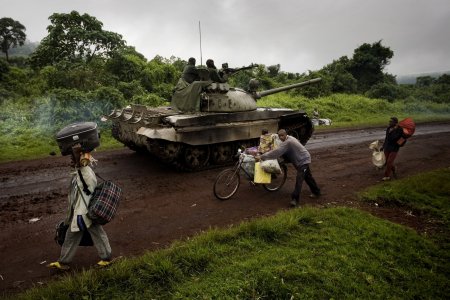
Entre morale du devoir et morale des conséquences, le droit humanitaire d'urgence, pourtant reconnu internationalement, est bien difficile à appliquer.
 Dominic Nahr
Analysis
Dominic Nahr
Analysis
08/01/2010
Fabrice Weissman
Argued in the 1990s in the name of the "right or duty to intervene", the application of military might to rescue populations in danger is now debated with reference to the "Responsibility to Protect" paradigm (or "R2P" for those in the know). In this article Fabrice Weissman explains why MSF refuses to adhere to this doctrine of ‘just war', whose legalisation would effectively be legalising a new form of imperialism.