

Motivations for mass violence: different interpretations
Nicolas Mariot
What turns ordinary men into killers? The CRASH team organized a conference – debate with the sociologist and historian Nicolas Mariot.Author of an article entitled « Faut-il être motivé pour tuer ? Sur quelques explications aux violences de guerre » (Genèses, n°53, 2003, p. 154-177) and books such as “Face à la persécution. 991 Juifs dans la guerre" (with Claire Zalc, Paris, Odile Jacob, 2010), “Tous unis dans la tranchée ? 1914-1918, les intellectuels rencontrent le peuple" (Paris, Seuil, 2013). This meeting, prepared with Claudine Vidal, was moderated by Elba Rahmouni.
Nicolas Mariot presented two different interpretations of motivations for mass violence in the 20th century, drawn from a series of studies and surveys on the subject.
The first interpretation is culturalist. It suggests that massacres are motivated by hate due to racism, antisemitism, nationalism, fundamentalism, etc. This suggestion that the motivation for killing is rooted in a culture of hate has convinced a broad public. Some journalists and political personalities find scientific credibility in a vision of the world that reduces mass violence (in Syria, Central African Republic and South Sudan) to identity-based conflicts between radicalised groups opposed to each other on the simple basis of cultural, ethnic and religious differences.
The second interpretation is situational. It looks at the specific places and times at which massacres occurred. Without denying the role played by fervour, it highlights the ability of political rationales, group effects and collective conditioning to turn ordinary men into killers: pressure from groups of “friends”, local or family solidarity, micro-local rivalries, etc.
These subjects are relevant to the analyses of situations in which we work.
To cite this content :
Nicolas Mariot, “Motivations for mass violence: different interpretations”, 3 octobre 2019, URL : https://msf-crash.org/en/conferences-debates/motivations-mass-violence-different-interpretations
If you would like to comment on this article, you can find us on social media or contact us here:
Contribute Jodi Bieber
Conference
Jodi Bieber
Conference
Les viols au coeur de l’activité guerrière au XX ème Siècle
12/01/2005 - 07:30 PM 08:30 PMStéphane Audoin-Rouzeau, chercheur et enseignant à l'EHESS, nous apporte un éclairage historique sur la question des violences sexuelles en situation de conflit.
 Eddy Van Wessel
Conference
Eddy Van Wessel
Conference
Extreme violence: investigate, rescue, judge. Syria, Rwanda, Democratic Republic of Congo
03/20/2019 - 02:00 PM 03/22/2019 - 05:00 PMTheaters of war, genocide, mass crimes, Syria, Rwanda and the Democratic Republic of Congo are at the heart of the international symposium organized by the platform L’humanitaire dans la globalisation of the Fondation Maison des sciences de l’homme (FMSH) and the Centre de Réflexion sur l'Action et les Savoirs Humanitaires (CRASH) of Médecins Sans Frontières. This symposium is part of the commemoration by these two institutions of the 25 years of the genocide of Rwandan Tutsis.
 Brendan Bannon
Dossier
Brendan Bannon
Dossier
Extreme violences: MSF experience in Rwanda
10/18/2017Several texts by members and associates of the CRASH published between 1994 and 2014 are united in this collection. In 2017, a book joins these publications: Humanitarian aid, genocide and mass killings: Médecins Sans Frontières, the Rwandan experience (1982-1997).
Read morePast events
 Conference
How to improve access to care and aid for people living with a handicap in a humanitarian context?
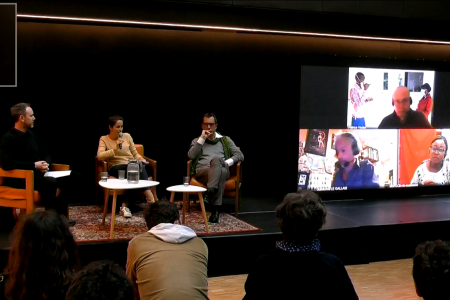
04/07/2022 - 06:30 PM 08:30 PMThe Crash team was pleased to invite you to the screening-debate of the film Agir contre l'exclusion, on April 7, 2022. The event was prepared and moderated by Elba Rahmouni.
 Conference
Reconstructing Lives
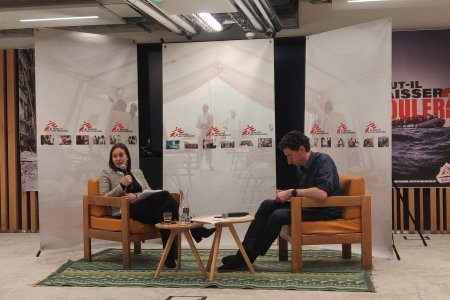
02/17/2022 - 06:30 PM 08:30 PMThe members of the Crash team were happy to welcome you all to an conference-debate with anthropologist Vanja Kovačič, on Thursday 17th of February. The author introduced her recently-published book "Reconstructing lives Victims of war in the Middle East and Médecins Sans Frontières" (Manchester University Press, translated in French and Arabic). This event, prepared with Jean-Hervé Bradol, was moderated by Michaël Neuman.
 Conference
Another approach to well-being at work
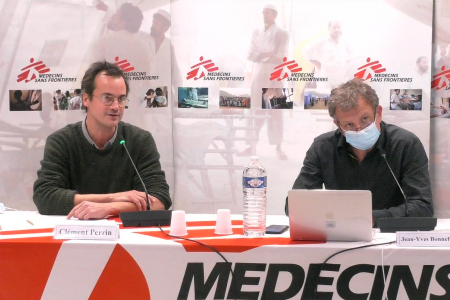
12/09/2021 - 06:30 PM 08:30 PMThe members of the Crash were very happy to welcome you all to this conference-debate with occupational psychologists Yves Clot and Jean-Yves Bonnefond, two of the authors of “Le prix du travail bien fait – La coopération conflictuelle dans les organisations” (Paris, La Découverte, 2021 ; co-written with Antoine Bonnemain and Mylène Zittoun). This event, prepared with Judith Soussan, was moderated by Clément Perrin.
 msf
Conference
msf
Conference
Book launch event - Violences extrêmes. Enquêter, secourir, juger République démocratique du Congo, Rwanda, Syrie
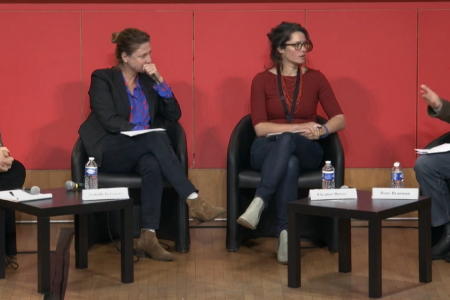
11/17/2021 - 06:30 PM 08:30 PMWe were happy to welcome Claudine Vidal, sociologist (CNRS) and Crash scientific committee member, and Jean-Hervé Bradol, doctor, former President of the French section of MSF and current director studies at the Crash, for the launching event of the newly-published book “Violences extrêmes. Enquêter, secourir, juger République démocratique du Congo, Rwanda, Syrie” (Éditions de la Maison des sciences de l’homme, Paris 2021). The event was hosted by Rony Brauman.
 Conference
Round Table - 50 years of Doctors without borders (Médecins sans frontières)
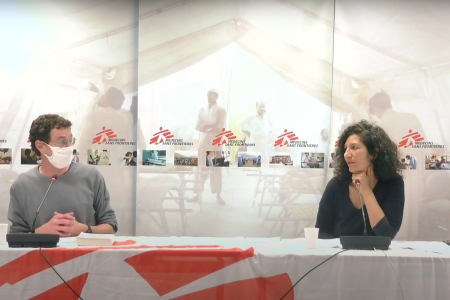
11/03/2021 - 07:30 PM 09:00 PMMédecins Sans Frontières celebrated its 50th anniversary. On this occasion and in the framework of the International Humanitarian Studies Association (IHSA) conference, the Crash organized a Round Table on the history of the organization, the myths surrounding it, and its recent evolution. This meeting, prepared with Elba Rahmouni, was moderated by Bertrand Taithe.
 Conference
Asylum and exile. A history of the distinction between migrants / refugees
04/12/2021 - 06:30 PM 08:30 PMOn April 12 2021, we were delighted to welcome Karen Akoka, political scientist and sociologist, fresh from her publication in November of “Asylum and Exile. A History of the Refugee/Migrant Distinction" (La Découverte, 2020). The author described and analyzed the trajectory of OFPRA, the French institution founded in 1952 and responsible for granting refugee status; she provided an insight into how the history of the distinction between migrants and refugees was established in France. This conference was prepared and moderated by Michaël Neuman.