
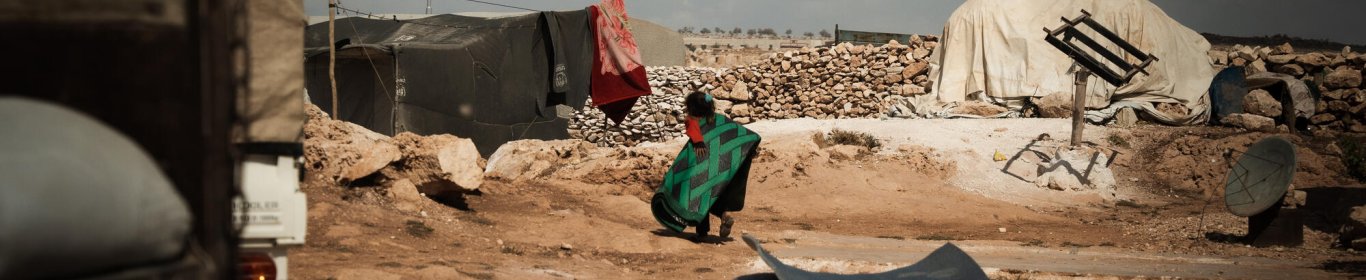
The challenges and dead ends of delivering aid in government-held areas in Syria
Ahmed Youssef , Agnès Levallois & Joseph Daher

Ahmed is currently the hospital director of the MSF reconstructive surgery hospital in Amman. He is also a former member of a humanitarian organization operating in government-held areas in Syria.
Agnès Levallois is an expert on Middle East issues, particularly on Syria. She is vice-president of the think tank iReMMO (Institut de recherche et d’études Méditerranée Moyen-Orient).
She is also a lecturer at SciencesPo Paris.
Joseph Daher teaches at the University of Lausanne, Switzerland, and is an affiliate professor at the European University Institute in Florence, Italy, where he co-coordinates the "Syrian Trajectories" research project. He is the author of "Syria after the Uprisings, The Political Economy of State Resilience" (2019) and "Hezbollah, the Political Economy of Lebanon's Party of God". He is also the author of numerous reports and articles in relations to Syria's economy, including the research collection entitled "Structured Chaos: how nonprofits in conflict settings became an economic sector".
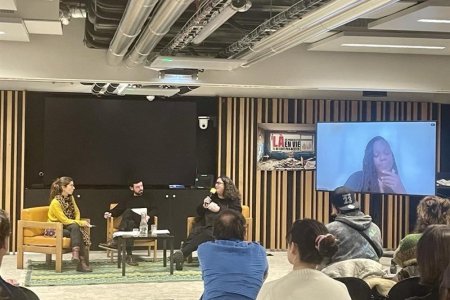
Crash and iReMMO were pleased to invite you to a round table discussion on the challenges, constraints, and limits of humanitarian aid in Syrian government zones. This meeting was prepared and moderated by Michaël Neuman.
Since the start of the war in 2011, Médecins Sans Frontières has been providing aid in Syria only in areas outside government control. Despite our numerous attempts, the authorities always refused our offers of work until the earthquake that struck the north of the country in February 2023. As part of a strategy to normalize diplomatic relations, the government accepted two major donations from the organization to the Syrian Arab Red Crescent (SARC) between February and April 2023. These donations and the ensuing negotiations, which were carried out with the aim of reaching an agreement on MSF's registration in Syria, gave rise to lively discussions within the organization: to what extent can we hope to negotiate an autonomous working space with a government which is responsible for mass atrocities, and which is described by researchers and human rights activists as exercising total control over international aid resources? Is humanitarian aid on the government side still condemned to "finance the Baathist repressive apparatus, [...] punish opponents and reward supporters" of the regime, in the words of Human Rights Watch in 2019? https://www.hrw.org/report/2019/06/28/rigging-system/government-policies-co-opt-aid-and-reconstruction-funding-syria
To answer these questions, we had the pleasure of welcoming Agnès Levallois, vice-president of iReMMO, consultant specializing in the Middle East and lecturer at Sciences Po Paris; Joseph Daher, professor at the European University Institute in Florence where he coordinates the ‘Syrian Trajectories' research project (online); Ahmed Youssef, now director of the MSF hospital in Amman and former member of a humanitarian organization operating in government-held areas in Syria (online); and Zahra Albarazi, Director of Programmes at the Syria Legal Development Programme (online). The meeting was moderated by Michaël Neuman, director of studies at Crash, Médecins Sans Frontières.
In partnership with iReMMO - Institut de recherche et d'études Méditerranée Moyen-Orient
To cite this content :
Ahmed Youssef, Agnès Levallois, Joseph Daher, “The challenges and dead ends of delivering aid in government-held areas in Syria”, 6 décembre 2023, URL : https://msf-crash.org/en/conferences-debates/challenges-and-dead-ends-delivering-aid-government-held-areas-syria
If you would like to comment on this article, you can find us on social media or contact us here:
Contribute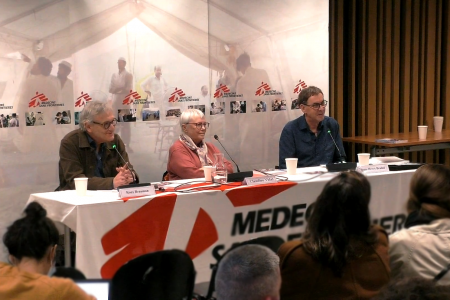 msf
Conference
msf
Conference
Book launch event - Violences extrêmes. Enquêter, secourir, juger République démocratique du Congo, Rwanda, Syrie
11/17/2021 - 06:30 PM 08:30 PMWe were happy to welcome Claudine Vidal, sociologist (CNRS) and Crash scientific committee member, and Jean-Hervé Bradol, doctor, former President of the French section of MSF and current director studies at the Crash, for the launching event of the newly-published book “Violences extrêmes. Enquêter, secourir, juger République démocratique du Congo, Rwanda, Syrie” (Éditions de la Maison des sciences de l’homme, Paris 2021). The event was hosted by Rony Brauman.
 Pierre-Yves Bernard
Opinion
Pierre-Yves Bernard
Opinion
Syria: Breaking the De Facto Humanitarian Embargo against Rebel-Held Areas
03/19/2013While European Union members are debating the lifting of arms embargo on Syria, populations living in opposition held territories continue to be severed from desperately needed humanitarian aid. Yet, there is a controversy among aid agencies on the best ways to scale up relief activities in Syria.
 Diala Ghassan/MSF
Analysis
Diala Ghassan/MSF
Analysis
Humanitarian Field Practices in the Context of the Syrian Conflict from 2011 to 2018
03/15/2021This article was first published in Issue 2, Volume 2 of The Journal of Humanitarian Affairs.
How can a medical humanitarian organisation deliver emergency assistance in Syria when there is nowhere in the country where civilians, the wounded and their families, medical personnel and aid workers are not targeted? Not in the areas controlled by the government, nor in those held by the Kurdish Democratic Union Party (PYD), Islamic State of Iraq and the Levant (ISIL) or the different rebel groups. So what action could be taken, and how? Remotely or on site? At the very least, we had to decipher the diverging political and military agendas, and then adapt, persist or sometimes just give up. In this article, I will present the full range of methods used to acquire knowledge and obtain information as well as the various networks used to carry out this venture. I will also show how Médecins Sans Frontières’ operations became a balancing act, punctuated by episodes of adapting to the various difficulties encountered.
Past events
 Maëlle Lefeuvre/MSF
Conference
Maëlle Lefeuvre/MSF
Conference
Waging war for peace
05/05/2026 - 06:30 PM 08:30 PMOn Tuesday, May 5th, 2026, at the headquarters of MSF (14-34 avenue Jean Jaurès, 75019), the CRASH team was delighted to welcome Sylvain Venayre, professor of contemporary history and writer, for a conference on the distant wars of the 19th century and the debates they continue to spark today. This exchange was prepared and moderated by Rony Brauman.
 Maëlle Lefeuvre/MSF
Conference
Maëlle Lefeuvre/MSF
Conference
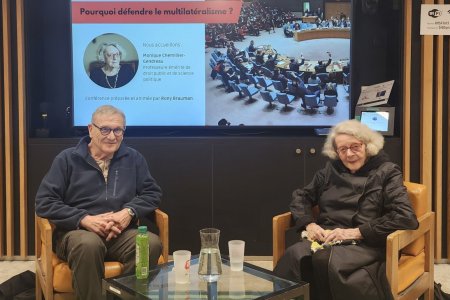
Why defend multilateralism?
03/24/2026 - 06:30 PM 08:30 PMOn Tuesday, March 24th, 2026, we had the pleasure of welcoming Monique Chemillier-Gendreau, Professor Emerita of Public Law and Political Science, for a conference devoted to multilateralism in the current geopolitical context. This event was prepared and presented by Rony Brauman.
 Mathilde Chong/MSF
Conference
Mathilde Chong/MSF
Conference
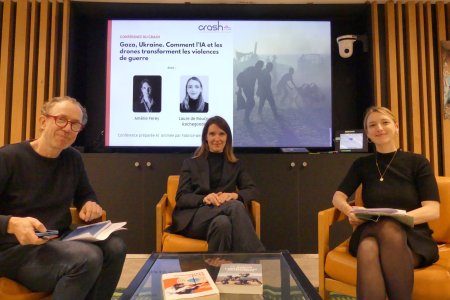
Gaza, Ukraine. How AI and drones are transforming the violence of war
10/14/2025 - 06:30 PM 08:30 PMOn Tuesday, October 14, 2025, the CRASH team was pleased to welcome Laure de Roucy-Rochegonde and Amélie Ferey for a conference on the transformation of war violence in the age of artificial intelligence (AI) and drones. The discussion was prepared and moderated by Fabrice Weissman.
 Conference
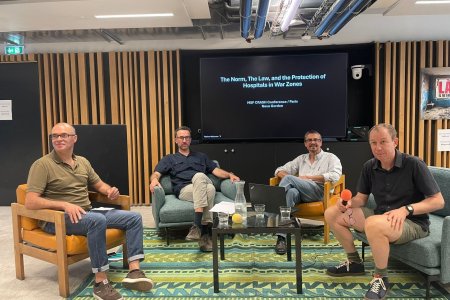
Human shields. When humanitarian law turns against war victims
06/12/2025 - 06:30 PM 08:30 PMOn Thursday June 12, 2025, the Crash team was delighted to welcome Neve Gordon and Nicola Perugini, for a conference entitled " Human shields. When humanitarian law turns against war victims". This meeting was prepared and moderated by Fabrice Weissman and Hakim Chkam.
 Conference
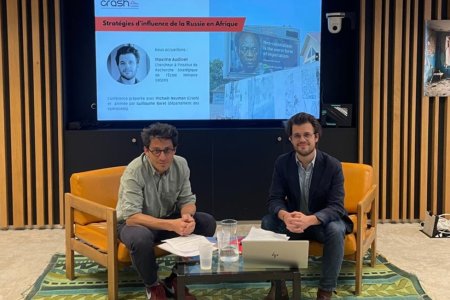
Russian influence strategies in Africa
04/03/2025 - 06:30 PM 08:30 PMOn Thursday April 3, the Crash team was delighted to welcome Maxime Audinet, researcher at IRSEM, for a conference on Russia's new trajectories in Africa. This meeting, prepared with Michaël Neuman (Crash), was moderated by Guillaume Baret (Operations Department).
 Conference
Port-au-Prince, Haiti: living and working in chaos?
02/06/2025 - 06:30 PM 08:30 PMOn Thursday February 6, the Crash team was delighted to welcome Romain Le Cour Grandmaison, Arnaud Dandoy, Pascale Solages and Sarah Chateau (MSF) for a conference entitled “Port-au-Prince, Haiti: living and working in chaos?”. This meeting was prepared and moderated by Judith Soussan.