
How can aid workers help war victims without falling prey to, or becoming complicit with, their persecutors?
Humanitarian organisations have an ambiguous relationship with the violence of war. Seeking to relieve its severity, they contribute to its continuation to varying degrees while subjecting themselves to becoming targets. This collection of studies explores the way aid workers attempt to “humanise” war and face the risk of becoming victims of or complicit in the war.
 Olivier Jobard/MYOP
Speaking Out Case Studies
Olivier Jobard/MYOP
Speaking Out Case Studies
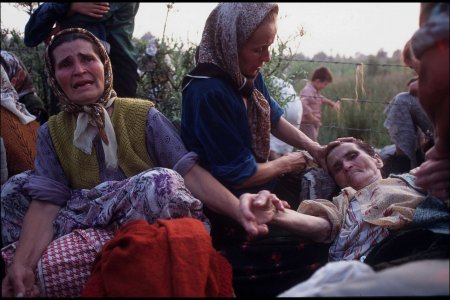
MSF and Srebrenica, 1993-2003
07/17/2015The case study ‘MSF and Srebrenica 1993-2003' explores the constraints and dilemmas raised when MSF spoke out about the events that occurred in Srebrenica's Muslim enclave.
Olivier Jobard/MYOP
Speaking Out Case Studies
MSF and Srebrenica, 1993-2003
07/17/2015The case study ‘MSF and Srebrenica 1993-2003' explores the constraints and dilemmas raised when MSF spoke out about the events that occurred in Srebrenica's Muslim enclave.
 Analysis
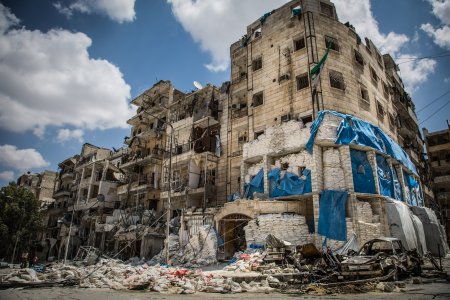
How humanitarians work when faced with Al Qaeda and the Islamic state
02/20/2015How to intervene with the civilian populations in the middle of the war in Syria? Jean-Hervé Bradol, director of studies at Crash and former project coordinator for the northern part of Syria in 2013, testifies about the negotiations carried out in Syria in cities taken by groups affiliated to Al Qaeda or the Islamic State. This article was published on the Mediapart website on February 1, 2015.
 Francesco Zizola
Analysis
Francesco Zizola
Analysis
The State of the Humanitarian Sector
01/30/2015This article is an English translation of an interview of Fabrice Weissman about the State of the Humanitarian Sector, in Revue Internationale et Stratégique (n°98, 2015/2) published by the Institut de Relations Internationales et Stratégiques
 R. Chalasani
Speaking Out Case Studies
R. Chalasani
Speaking Out Case Studies
Violence against Kosovar Albanians NATO’s intervention 1998-1999
06/23/2014This case study describes the constraints and dilemmas facing Médecins Sans Frontières teams that witnessed a process of terror and expulsion which they described as the ‘deportation' of Kosovar Albanians by Serb forces.
R. Chalasani
Speaking Out Case Studies
Violence against Kosovar Albanians NATO’s intervention 1998-1999
06/23/2014This case study describes the constraints and dilemmas facing Médecins Sans Frontières teams that witnessed a process of terror and expulsion which they described as the ‘deportation' of Kosovar Albanians by Serb forces.
 Remco Bohle
Speaking Out Case Studies
Remco Bohle
Speaking Out Case Studies
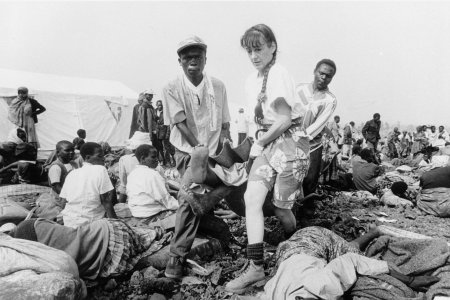
Rwandan Refugee Camps in Zaire and Tanzania 1994-1995
04/03/2014This case study is describing the constraints and dilemmas met by MSF when confronted with camps under the tight control of "refugee leaders" responsible for the genocide of the Rwandan Tutsis from April to June 1994.
 Corinne Dufka
Speaking Out Case Studies
Corinne Dufka
Speaking Out Case Studies
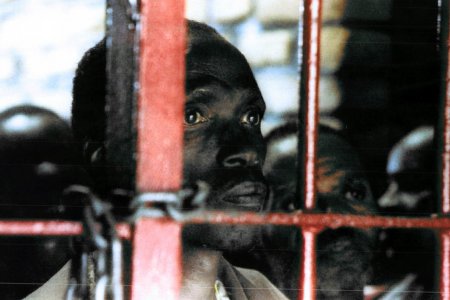
The violence of the new Rwandan regime 1994-1995
04/03/2014This case study is describing the difficulties and dilemmas that Médecins Sans Frontières faced in 1994 and 1995 when confronted with the abuses and crimes of the new regime that had taken over in Rwanda in July 1994.
 Roger Job
Speaking Out Case Studies
Roger Job
Speaking Out Case Studies
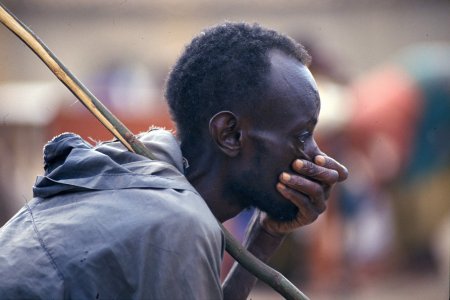
Genocide of Rwandan Tutsi 1994
04/03/2014This case study is describing the difficulties and dilemmas met by Médecins Sans Frontières (MSF) during the genocide of Rwandan Tutsis in April, May and June 1994.