

Back from Gaza, Jean-Guy Vataux gives a rare and harrowing account of the daily lives of Palestinians and rescue teams facing the Israeli army's "apocalypse strategy." He notably describes the perverse workings of a food rationing system designed to create chaos. This system has caused the deaths of hundreds of young Palestinians employed by shopkeepers to collect or loot food aid, while Israeli snipers enjoy shooting them in the back. The interview concludes with a chilling question: how can we respond to the Palestinians' call to flee this hell at any cost?
Jean Guy Vataux's debriefing was recorded on August 8, 2025, with Rony Brauman and Fabrice Weissman. Here are some excerpts from the podcast, originally produced in French.
Find the original podcast in French here : Gaza : quatre semaines au cœur de l’apocalypse | msf-crash.org
Introduction
Fabrice: "Gaza is one of the most dangerous and challenging missions for MSF. The teams live under the constant threat of bombing. They can barely feed themselves. We have lost nearly 12 colleagues since the start of the Israeli offensive. The last one was killed on July 4 while trying to retrieve food from one of the few food aid trucks allowed to enter the area."
Gaza, a disaster movie landscape
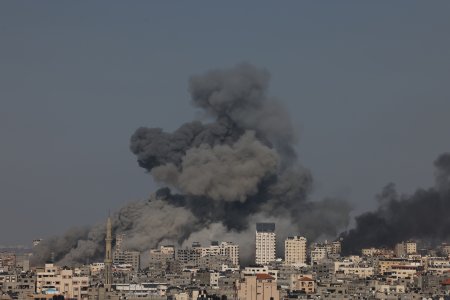
Jean-Guy. "The situation in Gaza is truly spectacular. Across vast areas, there are scenes that you would imagine in American disaster movies. You really have to see it to believe it, particularly the level of destruction, which is either the result of rage or a methodical campaign to eradicate a population, infrastructure, economy, culture, history—in short, civilization."
"I don't understand how any interview with a member of the Israeli government doesn't begin with this question from journalists: 'Why ban and kill journalists in Gaza? What do you have to hide? Why take such an utterly incredible measure?'"
When the Israeli army turns the Palestinian population into human shields
Jean-Guy. "The system for protecting the population is completely ineffective following the Israeli government's decision to force the Palestinian population to remain in the middle of the conflict zone, which means that all the other protective measures, however real, that the Israeli government boasts about are totally ineffective. And in fact, when you cross Gaza, it quickly becomes clear that the human shield that is thought to be used by Hamas was actually created by Israel. It's hard to see where Hamas could be, except in the middle of the population; there is no space to separate these two groups."
A food rationing strategy comparable to that of the Warsaw Ghetto
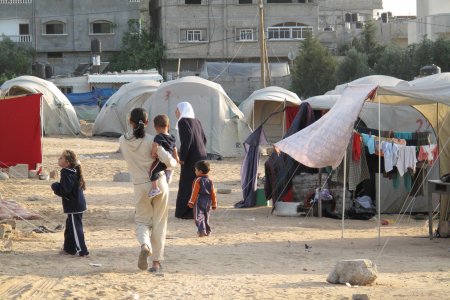
Jean-Guy. "I went to see the people in their camps to listen to what they needed. They have nothing to eat, the tents are too small, there isn't enough water, there are no latrines, there's no protection because in the white zones there's less bombing and less destruction than in the evacuated zones, the red zones, but there's still some. There's no hope, there are obviously no schools, none of the normal systems of life in a normal civilization are in place. We have people who are totally dependent on aid, aid that comes first from their immediate environment, from people who live nearby, who share what they have, a little food, a little water. And then there is humanitarian aid..."
"I don't think one can compare the situation in Gaza today to concentration camps, at least not to the concentration camps of World War II, which were mainly labor camps or death camps. In the situation in Gaza today, there is neither. On the other hand, we are approaching the situation of ghettos, including the ghettos during World War II. In the Warsaw ghetto, there was also a policy of food restrictions: only 15% of the normal calorie ration was allowed in. I think that for the past five months, it is exactly the same policy that has been in place in Gaza, at least regarding food."
Hungry young people employed by shopkeepers to collect or loot food aid under Israeli sniper fire
Jean-Guy. [During distributions by the Gaza Humanitarian Foundation (GHF), or when trucks from the World Food Program (WFP) arrive] "There is a crowd of young men who have come to look for food, who rush towards the trucks, jostling each other to get as much food as possible. And while this is happening, the Israeli army shoots at them like rabbits, literally. Between the start of these GHF relief operations and the end of July, these massacres of civilians who came to get food account for 20% of the deaths in the entire Gaza Strip and 35% of the wounded."
"The Israeli army always says, 'We only open fire when we are threatened, when people come towards us.' No one believes that. No one believes that today an unarmed young Palestinian is going to throw himself at an Israeli tank to fight. And on the other hand, I have seen enough of these wounded young people in the emergency rooms I visited at Shifa Hospital, Nasser Hospital, and elsewhere to tell you that for the majority, the entry point is in the back. They were shot in the back. And according to their own testimony, most of the time, when the shooting starts, everyone lies down on the ground, and it is at that moment, while they are still lying on the ground, that they are shot."
"It's become a job now. That's all these young people do. Every morning, they get up and go to the distribution site. The luckiest ones come back with a bag of flour, a few cans of beans, which they sell almost immediately as soon as they get back to town, in the displaced people’s camp, usually to shopkeepers, before going to rest and, the next morning, going back to the front. There is only one camp that is armed, but it is definitely a front line. Then they risk their lives again to go and find food. The young people say that they go in groups, which can be five friends or 50 members of a group that could be called a gang, sponsored by a shopkeeper who takes them to the site in a truck and sends them to find food. When they come back down, they get back in the truck, which takes them back to Gaza City or elsewhere in the north to sell the food. It's an ultra-liberal system. The proletariat risks its life to extract wealth, and the only wealth to be found today is food. They sell it cheaply to merchants who take a cut and then resell it at high prices, even very high prices, on the markets. This food is then made available to the most economically privileged segment of the population.
"I don't think any of us have ever seen anything like this: thousands of deaths, tens of thousands of injuries directly linked to a relief operation. We all have examples in mind where this has happened. The violence that used rescue operations was never on such a scale, it was never over such a long period of time. And here it is absolutely unbelievable. And what is unbelievable is that today, everyone has grown accustomed to it.
Rony. "Just as we have grown accustomed to hearing about dozens of deaths every day, announced between news items on the morning radio. Forty-five dead yesterday in Gaza, and then we move on to the sports results. It has become a kind of chilling daily routine."
Why shoot unarmed young people who are just looking for food?
Jean-Guy. "After all, these distribution sites were set up in the south to attract people to the south, where the Israeli state wants to keep them in the long term. It's not very appealing to welcome people with bullets... A plausible explanation is that we have soldiers who have been very undisciplined since the start of the conflict. Whenever there have been incidents, mistakes, including serious mistakes with diplomatic and political consequences, there have never been any sanctions. So, it's not impossible, and it's even plausible that these shootings are, I find it hard to say, but that they're shooting for fun, that it's become a game."
Rony. "It's documented, I don't think this is a matter of interpretation, since interviews with soldiers who were involved in these shootings have been conducted, notably by Ha'Aretz and +972, the two Israeli and Israeli Palestinian media outlets reporting on the course of this war. And they reported that officers were encouraging them to shoot. Those who testified were people who were opposed to this, who had refused these unacceptable orders. But clearly, the war in Gaza has opened an unexpected territory for psychopaths who have been in a free shooting range for months and are having a field day against people they consider monsters, killers of Jews, people who want their destruction and whom they themselves will destroy before being shot. It seems to me that there is something of this order, a mixture of colonial politics and strategy, of terror and of opening up a free field of initiative to psychopaths who have been brainwashed into believing that it is either them or us."
Jean-Guy. "I would add that, faced with human resource problems, the Israeli army is increasingly calling on settlers from the West Bank. When you see their behavior in the West Bank, you think that, yes, if they are stationed at a distribution site, they will shoot into the crowd.
Rony. "And there are more and more officers who are themselves settlers, and among the settlers, the most extreme, the most ideological.
A food distribution system organized to encourage looting, pillaging, and war of all against all.
Jean-Guy. "Massive diversions by Hamas have never been documented by the Israeli army, but USAID carried out an investigation and they did not find any either. The new aid system lends itself much more than the old one to accusations of diversion of aid. The GHF distribution sites are designed like this: I put trucks there and let the crowd come and take what is there. Who are these people, who is this crowd? It doesn't matter, there is no targeting, there is no monitoring afterwards. One can imagine that Hamas has gangs of its own who also go looking for food. In any case, the GHF has no way of preventing this, or even of finding out about it.
Rony. "On the other hand, it would seem that there are gangs supported by the Israelis, so they have much greater mobility and capacity to attack than Hamas, since they benefit from the protection of the Israeli army, which is organized to fight Hamas in the eyes of the Israelis, but also to profit from the situation. "
Jean Guy. "These gangs were very active in looting at the end of last year. They are much less so today. Today, they make their money rather by securing GHF operations. "
Jean Guy. "Israel is leaving the WFP to deal with a population that continues to starve, that is extremely anxious and potentially extremely violent. Every day, they continue to send 20 trucks, 30 trucks, over the past few months, which have been systematically looted by a hostile crowd. I believe that in three months, only eight trucks have arrived at the WFP warehouses out of I don't know how many hundreds. Speaking of dilemmas, here's a major one for the WFP: they could — and have, on several occasions — say, 'We demand the necessary security conditions before resuming operations.' Or they do what they’ve done almost every time: things don’t go very well, but at least some flour makes it into the Gaza Strip. Of course, the flour will be resold, and only part of the population will benefit — certainly not those it was originally intended for. Still, it's better than nothing. The dilemma remains stark, especially when we remember that there are regular fatalities during so-called 'self-distributions' — a polite term for what is essentially tolerated looting.
Fabrice. "At one time, the Israeli army was suspected, even accused, of preventing the Hamas police from securing supply convoys and thus allowing gangs of bandits to carry out their looting, because it was in their interest to fund this counter-power to Hamas."
Jean-Guy. "It remains true that Israel does not tolerate the Hamas police maintaining order around these food distributions. There have been two attempts by Hamas, through one of their brigades, to secure the WFP trucks when their return to the north, but they were shot at."
Jean-Guy. "Another thing the Israeli army is doing to make the disaster worse is imposing routes and schedules on the WFP that defy common sense. For example, the WFP has to request permission to collect 50 tons of food at the entrance to the Gaza Strip, all of which is in an evacuation zone. At that point, it is up to the Israeli army, with the approval of the Israeli security forces, to decide the route and schedule for collection. And quite systematically, these are routes and schedules that are completely unsuitable for the people in charge of security at the United Nations, who sometimes choose to abort the operation entirely or decide to take the risk, and things go quite badly. And so they sometimes end up exactly where the looters are waiting for them in the middle of the night, and disaster strikes."
Jean-Guy "At the beginning, when food supplies were very limited, people waited on the edge of the evacuation zones. That's where they waited for the trucks to come so they could help themselves. But very quickly, they saw that others who were more daring were entering the evacuation zones. And so, fairly quickly, most of the groups—I find it hard to call them looters, because they are really poor young people who have no other means of earning a living, of feeding themselves or their families—so these groups got as close as possible to the area where the trucks were entering and to the area actually controlled by the Israeli army, that is, where it is present with troops and tanks, in order to be the first served. They get to about 200 meters from the Israeli soldiers. This is a process that has developed, but it is not organized by the Israeli army. Except indirectly, in the sense that when you keep a population in a state of increasing starvation for several months, you can obviously expect people to resort to desperate measures to try to find food.
Jean-Guy: "This system of looting has been going on for several months, and I wonder if simply flooding the Gaza Strip will be enough to prevent looting. Can a food distribution system or a relief distribution system in general function without any organization to maintain order? I would remind you that yesterday Benjamin Netanyahu announced his plan, this new phase of ground offensive in Gaza, and he specifically stated that there should be an authority that is neither Israeli, nor Hamas, nor the Palestinian Authority. But he himself has given absolutely no indication of who he sees as the holder of authority in Gaza in the coming months."
Rony. "Yes, I think the phrase he used was 'we want to control but not govern'. But that's a total contradiction, it's just hot air to fill the void because such a situation does not exist. And it seems to me that this is consistent with the objective of this attack: a strategy of despair, a strategy of apocalypse, if you will, or at least of chaos."
International teams on a vegan diet
Jean-Guy. "First of all, we bring quite a lot of food with us in our bags. They let us bring food in. And then for the Médecins Sans Frontières teams, there are two meals a day, not three: there's one in the morning, delivered by an outside service provider, a Palestinian caterer who supplies us but with very limited resources. In a month, there hasn’t been any meat, there hasn’t been any fish. It's flour-based foods, rice with a little tomato sauce and sometimes hummus, canned beans.
Markets under pressure
Jean-Guy. "Some markets are not really supplied. There are old stocks, which may be spare parts for machinery or school supplies that no one buys because there are no schools. As for food, it depends on the day. During my stay, there was a period during when there was almost no food because it had become dangerous. The shopkeepers could no longer control the crowds. They preferred to stop selling at the market. Perhaps there were private sales within their networks of friends, clans, or other groups. But at that time, there was no food on the market. These were the period documented by AFP, since journalists who pay to work in Gaza, despite their financial resources, could not find anything at all on the market. This was also the case for our colleagues at Médecins sans frontières, who, despite having income and being able to pay €40 for a kilo of flour if they were reduced to that, could not even find a kilo of flour to buy for €40.
"The humanitarian pause declared by Israel has led to a reduction in the number of strikes, at least during the day, on the Gaza Strip. It also led to a slight increase in the number of trucks allowed in, including trucks carrying medicines, for example. We were able to get some in after being blocked for three months. And then there are the food trucks. For three months, the WFP was limited to bringing in 10 or 20 trucks a day. Since the humanitarian pause, between 100 and 130 trucks a day are entering the Gaza Strip. All of this has had a positive impact on market prices, which have actually fallen over the last 10 days."
Medical work: "It's not medical staff or supplies that are most lacking, it's space. We're creating the wounded."
Jean-Guy. "The main problem is the overcrowding in emergency rooms, the waves of wounded people who flood into Gaza's hospitals every day: the large hospitals, al-Shifa or Nasser, for example, or the smaller hospitals and field hospitals run by the ICRC and MSF Belgium, for example. It is this constant influx of wounded people that means medical teams have no space to receive them, cannot absorb them, cannot triage them, or begin treatment, or provide proper medical guidance. And in trying to do this, the medical teams treat people extremely quickly and discharge them far too quickly."
MSF's priorities: responding simultaneously to the needs of a refugee camp and an active conflict zone
Jean-Guy. "For MSF France, it was mainly a choice of conflict zone and therefore a choice of surgery. For the Spanish section, it's the opposite: they chose the refugee camp and therefore medical operations, maternity care, pediatrics, and primary health care. The Belgian section does a bit of both. However, the refugee camp situation has not escaped anyone's attention, as all sections carry out very large water distribution operations. I think we are the second-largest water supplier in the Gaza Strip overall. We have never distributed so much water over such a long period of time at Médecins Sans Frontières. And then, of course, there is nutrition, which is something we are not really involved in, mainly due to a lack of supplies. We do not have access to sufficient quantities of therapeutic food to allow us to open large refeeding centers as we would anywhere else."
The medical supply chain managed by the WHO under fire from the Israeli army
Jean-Guy. "For several months, we had enormous difficulty getting a truck in. The Israeli authorities prevented us from doing so. Then, with the humanitarian pause, we managed to bring in part of what had been pre-positioned in Israel and Egypt. We bring in our medical aid trucks under the cover of the WHO. Medicines have no market value in Gaza today, but we'll see if that lasts. There are signs and loudspeakers telling the crowd, 'These are not food trucks, these are medicine trucks, don't waste your time coming to loot them,' and community leaders are working to keep people informed along the road. This is what allows medical aid trucks to reach the warehouses, unlike food aid trucks."
"During a ground operation south of Deir el-Balah 15 days ago, the Israeli army entered this area where many humanitarian workers live and where medical facilities are located. And they destroyed the largest WHO warehouse in the Gaza Strip, a warehouse I had visited three days earlier when we went to pick up supplies. It was a huge warehouse, several thousand square meters in size, about half full, and it was completely destroyed during a ground operation by the Israeli army."
"On the same day, they attacked a house where Palestinian WHO staff were staying, a house clearly identified as a humanitarian site. There, they humiliated all these people. They forced the women to flee on foot several kilometers to the south. The men were stripped naked before being interrogated and humiliated. Then they released them, except for one who they kept in detention and who is still being held. The Director-General of the WHO has made regular calls for his release. Following this day, when the WHO seemed to be particularly targeted, there was a public response from the Israeli army, in their usual style, which was to say, 'Be careful, sometimes what is written or what people are supposed to do is not what they actually do.' Of course, there was no follow-up, and they never explained what was really going on. Once again, I visited this warehouse three days before and it really looked like a medicine warehouse, not a weapons warehouse.
Rony. "In any case, the Israeli army's demonstration regime is clear. This warehouse was a place of terrorism, and the proof is that it was shot at."
The safety of teams is at the mercy of a highly sophisticated and effective military-humanitarian coordination system that has worked well to this day.
Jean-Guy. "To this day, our safety depends entirely on the Israeli army. Basically, they either bomb us, or they don't. So, 99% of our safety work is linked to the Israeli army and takes place in Israel. We have a full-time position dedicated to this in the Israeli army's military-humanitarian coordination command center, which ensures that they are aware of where we are and where we are going. Ultimately, this system relies solely on the idea that the Israeli army does not want to kill us and that it has the means to avoid killing us. If it weren't for this sophisticated system of notifications, sites, movements, and so on, we could never operate in an area where the right people are targeted so often and so close to us."
"We are not present in the Israeli army headquarters, but in an ad hoc unit that coordinates between humanitarian workers and the military. This takes place in a barracks in Beer-Sheva. There are screens, computers, and representatives of the Israeli army whose job it is to do this. On the other side are representatives of the United Nations (who are responsible for passing on information to all international NGOs), the ICRC, World Central Kitchen (which also has a place in this room following the serious incident that affected them) and Médecins sans frontières. We are among the lucky few who are in this room every day."
"There is constant communication about where we are and where we are going. A number of these transports can only take place after express agreement from the Israeli army. We could go without it, but we have chosen to wait for the Israeli army's approval, which tells us, 'Yes, you can leave Deir el-Balah to go to Gaza.' With this agreement comes a commitment not to bomb us, to be careful. The movements for which we choose to wait for the agreement of the Israeli authorities are those that will approach or cross areas under evacuation orders."
"The level of violence we have been subjected to is still much lower than the level of violence experienced by the average civilian in Gaza. So, there is something that works in this system."
The mindset of our Palestinian colleagues: leave at any cost
Jean-Guy. "Most of the people I spoke to want to flee. I didn't meet anyone who said, 'No, I'm going to stay, I'll wait for this to pass, or I'll hang on.' Everyone wants to flee. But at the same time, of course, most of the people I talk to are employable elsewhere in the world. They are nurses, doctors, people who have hope. The displaced people in the tents didn't talk about fleeing to France. They only hoped for one thing: a ceasefire. The MSF staff, the people I talk to, obviously hope for a ceasefire, but also for a ticket out anywhere, as long as it's out of Gaza."
How can we respond to the call of Palestinians who want to flee this hell?
Jean-Guy. "The only future possible today is this humanitarian city that must be built in the south of the Gaza Strip, where people would be confined, kept on life support, for those who cannot be evacuated outside the borders of Palestine and Israel. I have in mind a doctor who told me, 'But tomorrow, if they open the humanitarian zone, I'm going, as long as it's an area where we're given food and there are no bombings'. People would therefore prefer this humanitarian city of Israel Katz, the Minister of Defense, rather than remaining constantly under fire or in any case in danger and with the food shortages being imposed on us. It is still immense despair that makes a population, known to be attached to its land, say that the only thing it wants is to flee, and that if it cannot flee, it would rather find itself in a re-education camp run by the Israeli army than stay where they were born and where grew up."
Rony. "80% of Israelis approve of the idea of expelling Palestinians from Gaza. This isn't the far right, it's the entire Israeli political class apart from the left. This has been a fundamental strategic principle in Israeli politics since Ben Gurion, so it's not at all new from that point of view. The slogan is 'more land with fewer Arabs'. So, bringing 'Arabs"’ into Israel, to use the vocabulary of the Israeli right, is the exact opposite of everything they have been doing for 75 years. It's not on the agenda at all; it's completely unthinkable. That said, it's estimated that around 100,000 Palestinians have managed to leave Gaza and reach Egypt. The number is small compared to the population of Gaza, but it's still significant. Furthermore, the Egyptians, at least for now, do not want this. But I should point out that there are Israeli American exploratory missions in all the neighboring countries, in Libya, Egypt, Jordan, Puntland, and other places, to examine the possibilities for resettlement. For example, the Americans are ready to unfreeze Libyan assets held in the United States in exchange for Libya taking in several hundred thousand Palestinians. There is a strategy under way, but I don't know if it will succeed."
Jean-Guy. "There was a time when we thought that the Israeli army's objective was to push the Palestinians out, and as MSF we didn't want to help them do that. That’s the kind of thing you can say when you're not certain about what's going to happen on the ground. But now we've seen it clearly: militarily, the war has been won, there's no doubt about it. We've seen the level of despair among the Palestinian population today and, above all, what they wish for. It's very difficult to talk to a Palestinian who isn't asking for a ticket out of the country as soon as the ceasefire is declared. I think our little metaphysical doubts about whether, or not, we were participating in the Israeli army's plan have been dispelled. In any case, given the military and political situation, if we want to do something that in one way or another does not contribute to the Israeli project, then we do nothing."
Return to Jerusalem
Fabrice: "In a few days, you're supposed to return to Jerusalem to take up your position again as head of mission and therefore your meetings with Israeli officials. How do you feel about this prospect after your stay in Gaza?"
Jean-Guy. "If I am admitted into Israel, I will continue working to negotiate access for people and goods into Gaza, and for people to be evacuated out of Gaza. Israeli society is no more complicated than any other. There are five or six major schools of thought that people follow, either out of habit or conviction. So not everyone is an ultra-violent racist segregationist, like some of the parties in the current government coalition. Israel is a large enough country that we don't have to feel completely crushed by the idea that we are only talking to heartless monsters who are responsible for what's being done in Gaza today."
Transcription: Oriane Albouy
Translation : Nayla Adjout
Selection of quotations and editing: Elba Rahmouni
 Nour Alsaqqa/MSF
Interview
Nour Alsaqqa/MSF
Interview
Rony Brauman : « Gaza est devenu le lieu de tous les records... »
07/03/2025Dans cet entretien mené par Pierre Lagnel pour Golias Hebdo, Rony Brauman aborde la situation à Gaza, le positionnement des Etats occidentaux, la confrontation avec l'Iran et la couverture médiatique du conflit. Il appelle encore une fois la société civile à se lever contre les massacres en cours dans lesquels la Cour internationale de justice voyait dès le début 2024 « un risque de génocide ».
 MSF
Analysis
MSF
Analysis
Préface à l'ouvrage "Le Livre noir de Gaza"
10/07/2024Le Livre noir de Gaza est un ouvrage paru le 4 octobre 2024 aux Éditions du Seuil. Il recense autant que possible les faits qu’ont pu établir les ONG internationales, palestiniennes et israéliennes, depuis le début de la guerre. Il est construit à partir de leurs rapports, d’enquêtes d’experts et d’articles de presse, sélectionnés et introduits par la spécialiste du Moyen-Orient Agnès Levallois, avec les contributions inédites de consultants indépendants et responsables d’ONG. La préface a été rédigée par Rony Brauman.
 Valerie Babize
Opinion
Valerie Babize
Opinion
Gaza: Alive, but slimmer
11/14/2012Last October, the Israeli Minister of Defence resolved under judicial order to declassify documents dating from January 2008. These archives contain the implementation details of the embargo imposed on Gaza in 2007.