
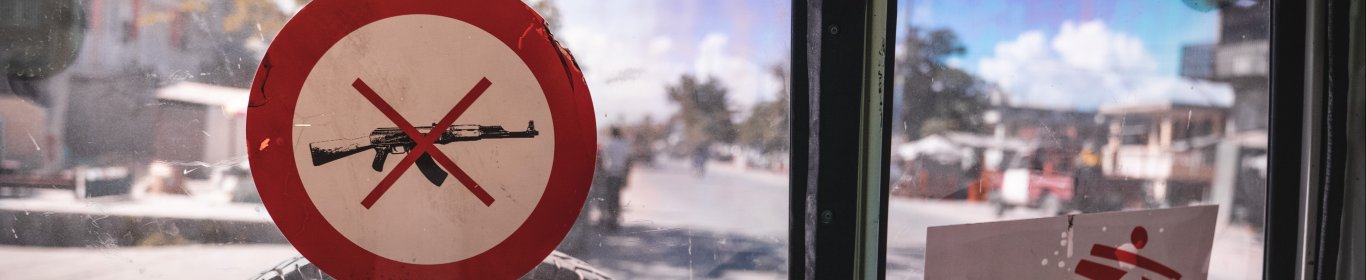
Armed escorts - neither for nor against
Rony Brauman
Medical doctor, specialized in tropical medicine and epidemiology. Involved in humanitarian action since 1977, he has been on numerous missions, mainly in contexts of armed conflicts and IDP situations. President of Médecins sans Frontières from 1982 to1994, he has taught at the Humanitarian and Conflict Response Institute (HCRI) at the University of Manchester (UK) and at Sciences Po Paris. He has published several books and articles, including "Guerre humanitaires ? Mensonges et Intox" (Textuel, 2018), "La Médecine Humanitaire" (PUF, 2010), "Penser dans l'urgence" (Editions du Seuil, 2006) and "Utopies Sanitaires" (Editions Le Pommier, 2000).
Caught between humanitarian commitment to vulnerable populations and security concerns, the issue of the use of armed escorts by humanitarian organisations raises some fraught questions. Médecins Sans Frontières has adopted this practice, controversial as it is, in a number of contexts throughout its history. Can we resort to this type of protection without compromising our neutrality? Are MSF's image and the very safety of its teams threatened by being so close to armed actors?
Challenging the consensus
The answers to these questions are generally in the affirmative at MSF – and at the International Committee of the Red Cross (ICRC) – as one might intuitively think and confirm from reading legal documents on the subjectSee https://international-review.icrc.org/sites/default/files/reviews-pdf/2021-12/armed-escorts-to-humanitarian-convoys-ihl-914.pdf: “MSF has generally maintained a position that the use of armed escorts for the protection of its operations is not allowed. This is due to the acknowledgement that being visibly identified as “protected” by an escort armed of, associated with, or perceived as a party to the conflict no doubt jeopardises fundamental principles guiding MSF’s humanitarian actions - neutrality and impartiality”See ILD memo “Legal Opinion on the Use of Armed Escorts and its Adverse Effects”..
It is possible, however, to take a very different view, based on an examination of the link between neutrality, supposedly compromised by the use of armed escorts, and security, theoretically enhanced by respect for principles. Let us begin by pointing out that the idea that neutrality and impartiality are essential for gaining access to a population is not borne out by the facts. It is important to clarify that there is no disagreement here that neutrality, in the sense of non-partisan assistance, and impartiality, in the sense of fair action, sit at the very heart of humanitarian culture. This is arguably the very definition of humanitarian aid.
Being recognised as neutral and impartial should be enough to gain unhindered access to victims and help them without being targeted by combatants. This is the underlying premise of international humanitarian law (IHL) – and therefore the conventional obligation of the belligerents – and is central to the ICRC’s promotion of IHL as one of its raisons d’être. It is a premise shared by many humanitarian-aid organisations, first and foremost MSF, for whom it is not, however, a raison d’être.
Although this assertion may seem like reasonable conjecture, since it removes humanitarian aid from the logic of confrontation, it must be recognised that it is not borne out by an examination of the real situation in the field as experienced by MSF during its fifty-year existence. MSF's joint experience of “security incidents” – and that of other humanitarian organisations, including the ICRC – does not support the theory of a link between neutrality and security. MSF has used various forms of armed protection with no retaliation by the other belligerents, and no fatal incidents have ever been identified as a consequence of a breach of neutrality.
An historical overview
The association’s first debate on this subject dates back to 1991 and the war in Somalia, when MSF recruited armed guards to protect its facilities and movements. Incidentally, the ICRC acted in a similar manner. This decision was the subject of bitter discussion, as we effectively became the employers of an armed force and therefore potentially responsible for deadly fire, but also ultimately dependent on that very armed force. Subject to further research, Somalia is the only instance where MSF has found itself in such a situation.
Until then (and since its first operations in conflict situations in Iraqi Kurdistan and Eritrea in the 1970s, and Afghanistan, Angola, Chad and Eritrea in the 1980s) MSF had operated convoys and passages under the protection of guerrilla forces without question. Admittedly we were only present in the regions controlled by the armed opposition – not by choice but by circumstance, as the official authorities were hardly open to the presence of NGOs at that time. Far from being criticised, this practice was in fact valued as a contribution by the “French doctors” to traditional humanitarian action. The practice was curtailed in the 1990s, not because it was problematic but because of a context transformed by the end of the Cold War and the opening up of countries and regions previously closed to humanitarians. In this new context, our missions became more effective and efficient by being conducted in a formal and open manner – so nothing to do with respect for any particular principles which, incidentally, were not invoked in this instance.
The deployment of so-called “military-humanitarian” armed contingents in this new post-Cold War world order, brought MSF into this new landscape. We wanted to keep our distance from these international troops in blue helmets, largely to stay alongside the excluded in this new order who were often in a very precarious situationThe “Populations in Danger” series was designed to analyse these new intervention situations. The first volume was published in 1992.. Serving those most in need – our objective – meant distancing ourselves from these armed forces. Note that the principle of impartiality could have justified the opposite stance, i.e. helping as many people as possible would have meant aligning ourselves with the UN contingents. The principle of impartiality can therefore be found in both these objectives, both of which are honourable.
It was, however, during this period of rapid growth in humanitarian aid, marked by US-led multilateralism and the notion of “liberal peace” (“Wilsonianism in boots” in the words of political scientist Pierre Hassner), that the Dunantist and Wilsonian categories of NGO emerged, as well as the technical and ethical recommendations applicable in crisis situations. MSF as a whole became closer to the ICRC, not only in joint operations (Kigali in 1994 and Ghazni in 1996) but also, and above all, by co-promoting IHL and the three fundamental principles of the Red Cross. This is the era of Neutral Impartial Independent Humanitarian Action (NIIHA), of which MSF considers itself an eminent representative, second only to the ICRC.
The increasing number of security incidents (attacks, murders, kidnappings) at the turn of the millennium and since, therefore occurred at a time when we were constantly reaffirming our principles. Neutrality was gaining in importance as the supposed prerequisite for the acceptance and immunity theoretically conferred by NIIAH, and thus as a condition for action itself. By adopting this approach, MSF was distancing itself from what was really going on, as many current situations serve to remind us: Burkina Faso, where MSF is regarded as an accomplice to the jihadists, since we claim to be in contact with all belligerents; Haiti, where MSF is criticised for being the gangs’ health service for the simple reason that we admit any sick or wounded person to our facilities; Afghanistan, where all NGOs worked under the aegis of the MOH which was linked to NATO forces, and were in fact collaborating with the occupying forces.
Beyond the issue of armed escorts: negotiating security and the importance of IHL
This brief history of the development of the principle of neutrality at MSF is intended to remind us that it only became established in the second half of the organisation’s existence, and that it was not established on the basis of an analysis of the security conditions on the ground and of incidents, but on the idea that it should enable action to be taken. The books Humanitarian Negotiations Revealed: the MSF ExperienceHumanitarian Negotiations Revealed: the MSF experience | msf-crash.organd Saving Lives and Staying Alive: Humanitarian Security in the Age of Risk ManagementSaving Lives and Staying Alive: Humanitarian Security in the Age of Risk Managementfeature analyses and investigations which show that it is not our supposed principled virtues, but the interest local political authorities have in the service we provide that opens doors to countries and the possibility of acting. As for the above-mentioned incidents, there is nothing to link them at the time or with hindsight to a lack of (perceived) neutrality.
In these circumstances, the absence of a “clear framework, of general criteria for defining exceptions [to the rejection of armed escorts]”ILD memo.is not a shortcoming or weakness, but rather an invitation to consider each situation on its own merits where security issues are concerned. What is appropriate in one context may not be in another; the risks may be unacceptable here, but acceptable elsewhere. Perceptions and balances of power vary according to place and time: no fundamental principle, other than that of trying to be useful and staying alive, reflects this variety of risks.
It should also be borne in mind that IHL does not prohibit the targeting of humanitarian facilities and convoys, especially when an escort or armed group is a party to the conflict. Belligerents must not therefore impose the presence of military forces on humanitarian workers, just as they must make a distinction between civilians and combatants and, more generally, not inflict “excessive suffering”. In practice, however, it is the belligerents who decide what is “excessive” and what is a necessary aspect of war.
What is the purpose of IHL? MSF’s reply is that, in addition to its ambition to civilise war, it “provides humanitarian actors such as Médecins sans Frontières with arguments that enable them to negotiate their relief actions with the belligerents”Droit humanitaire (1/5) : définitions, principes et enjeux | Médecins sans frontières. This practical application is indeed valuable, but the point here is not to dispute it, but to consider it in a real-life situation.
It is certainly not a pointless exercise to try and provide a framework for the use of armed protection as an exceptional measure, but when we try to assess the risks, we must take account of what actually happened during the dramatic incidents we have experienced. Over the past two years, MSF has seen a significant increase in severe incidents, mostly in Haiti, Sudan and PalestineHow do you explain the spectacular increase in serious security incidents recorded by MSF France in recent years? | msf-crash.org. In the latter two countries, these involved attacks on health facilities and indiscriminate bombing, but again, none of these incidents is related to a breach of the principles of neutrality and impartiality.
On the contrary, asserting these principles can even lead to threats because of supposed complicity with the “terrorists” or “bandits” involved. In any case, even though IHL helps us adopt a position with our opposite numbers, it is no substitute for “the concrete analysis of a concrete situation”, as Marx famously put it.
To cite this content :
Rony Brauman, “Armed escorts - neither for nor against”, 1 septembre 2025, URL : https://msf-crash.org/en/humanitarian-actors-and-practices/armed-escorts-neither-nor-against
If you would like to comment on this article, you can find us on social media or contact us here:
Contribute Hareth Mohammed/MSF
A to Z
Hareth Mohammed/MSF
A to Z
Deconfliction: an effective protection arrangement?
09/01/2025As deconfliction has become a central tool in civil-military relations within conflict zones, this concept — rooted in military jargon — raises serious questions about its actual effectiveness. Michaël Neuman examines the origins, uses, and ambiguities of these mechanisms meant to protect humanitarian actors, while highlighting the risks of replacing legal guarantees with limited contractual arrangements.
 A to Z
What “solidarity” means for MSF: the uses and applications of a notion
08/01/2025A central concept in humanitarian discourse, international solidarity has established itself as a hallmark of emergency and development interventions. But what does this widely used term truly encompass? This article explores the various dimensions of solidarity, its political and symbolic stakes, and examines the concrete practices it generates within humanitarian organizations, particularly Médecins Sans Frontières (MSF).
 A to Z
Political use of famine
09/01/2025For governments, relief actors and international organizations, the classification of famine is a source of tension, due to the political, media-related, humanitarian, financial and emotional stakes involved. But what is famine, what criteria and data are used to define it, and by whom? Who declares it, and what are the public and political uses of such declarations? These are some of the questions examined in this article by Michaël Neuman.