
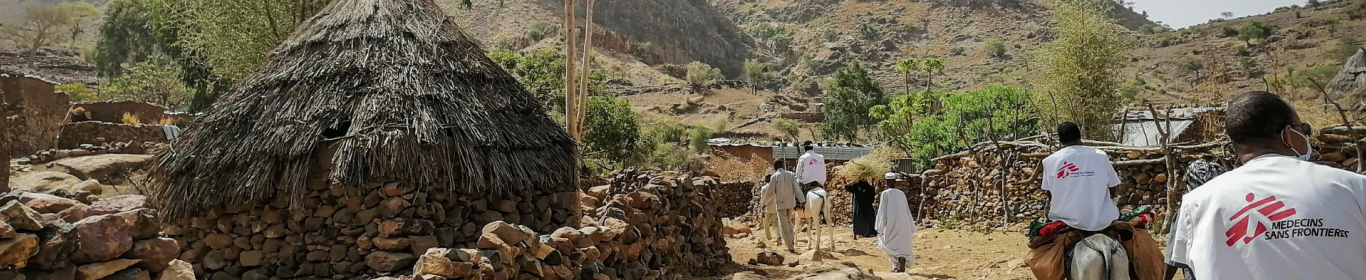
A critique of MSF-France operations in Darfur (Sudan). October 2003 - October 2004
Corinne Danet, Sophie Delaunay, Evelyne Depoortere & Fabrice Weissman

A political scientist by training, Fabrice Weissman joined Médecins sans Frontières in 1995. First as a logistician, then as project coordinator and head of mission, he has worked in many countries in conflict (Sudan, Ethiopia, Eritrea, Kosovo, Sri Lanka, etc.) and more recently in Malawi in response to natural disasters. He is the author of several articles and collective works on humanitarian action, including "In the Shadow of Just Wars. Violence, Politics and Humanitarian Action" (ed., London, Hurst & Co., 2004), "Humanitarian Negotiations Revealed. The MSF Experience" (ed., Oxford University Press, 2011) and "Saving Lives and Staying Alive. Humanitarian Security in the Age of Risk Management" (ed., London, Hurst & Co, 2016). He is also one of the main hosts of the podcast La zone critique.
In September 2004, the Board of MSF-France decided to undertake a critique of the section’s operations in Darfur in 2003 and 2004. According to the terms of reference set by MSF-F president Jean-Hervé Bradol (see appendices), the aim was less to ‘evaluate’ our intervention than to subject it to a critical examination which would enable us to “identify our weaknesses and the ways in which they can be corrected.”
The critique was coordinated by Sophie Delaunay and Fabrice Weissman under the supervision of Marie-Pierre Allié and Virginie Raisson for the Board.3 Its focus was confined to the operations conducted in Darfur (therefore excluding aid to Sudanese refugees in Chad) in the twelve-month period between October 2003 (when the first exploratory missions were launched) and October 2004
Methodology
How did we proceed? The initial difficulty involved the translation of the three major problematics (relevance, efficacy, efficiency) into concrete issues. The task was complicated by the fact that the Darfur intervention had not presented any major malfunctions that could have formed the start of our investigations. There was no resounding ‘failure’ to indicate immediately which aspects of the mission had raised issues concerning its relevance, effectiveness or efficiency; or to what extent we should search for examples of a possible malpractice. We had our grand problematics, but were still somewhat unsure of how to proceed, given the sheer scale of the operation and the fact that it was generally regarded as a success. We therefore sought to trace the mission’s progress by examining the evolution of the crisis, the activities carried out by MSF (operations and communications), and their impact (in terms of health and policies), while defining the constraints and the range of options available to the teams at each stage.
The team therefore focused on the following evaluation points:
-
Interpretation of the intervention context and selection of humanitarian objectives within that context;
-
Activities implemented and results achieved;
-
Adequacy of resources and organizational structure.
 Voitek Asztabski
Speaking Out Case Studies
Voitek Asztabski
Speaking Out Case Studies
MSF and Darfur 2003-2009
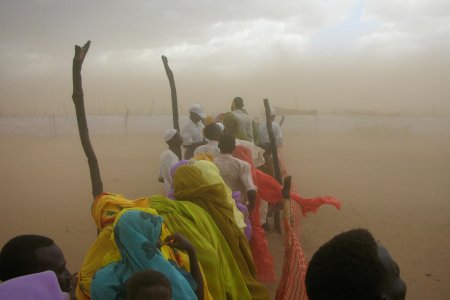
09/01/2024The “MSF and Darfur 2003-2009” case study describes the constraints, questions and dilemmas faced by MSF with regards to speaking out about extreme violence, massive displacements and terrible survival conditions endured by the population in the Darfur region, Sudan, between 2003 and 2009.
 Victor J. Blue
Analysis
Victor J. Blue
Analysis
War Breaks Out: Interpreting Violence on Healthcare in the Early Stage of the South Sudanese Civil War
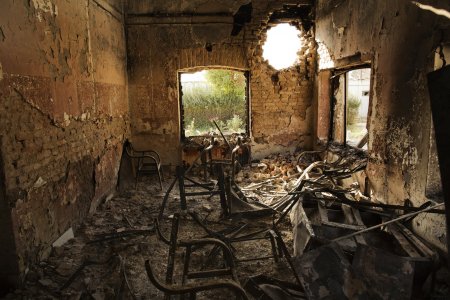
11/22/2019This article seeks to document and analyse violence affecting the provision of healthcare by Médecins Sans Frontières (MSF) and its intended beneficiaries in the early stage of the current civil war in South Sudan. Most NGO accounts and quantitative studies of violent attacks on healthcare tend to limit interpretation of their prime motives to the violation of international norms and deprivation of access to health services. Instead, we provide a detailed narrative, which contextualises violent incidents affecting healthcare, with regard for the dynamics of conflict in South Sudan as well as MSF’s operational decisions, and which combines and contrasts institutional and academic sources with direct testimonies from local MSF personnel and other residents. This approach offers greater insight not only into the circumstances and logics of violence but also into the concrete ways in which healthcare practices adapt in the face of attacks and how these may reveal and put to the test the reciprocal expectations binding international and local health practitioners in crisis situations.
 Analysis
The International reaction to the Darfur Crisis: An Humanitarian Point of View
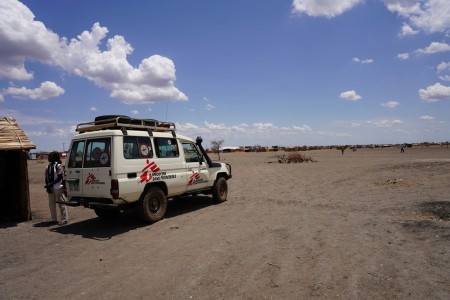
02/22/2007Fabrice Weissman looks at the major stages of the Darfur conflict since 2003 from the perspective of a humanitarian medical organisation. He questions the predominant reading of this crisis, and cautions against the illusions of international armed intervention in the region.
To cite this content :
Corinne Danet, Sophie Delaunay, Evelyne Depoortere, Fabrice Weissman, A critique of MSF-France operations in Darfur (Sudan). October 2003 - October 2004, 1 janvier 2007, URL : https://msf-crash.org/en/humanitarian-actors-and-practices/critique-msf-france-operations-darfur-sudan-october-2003-october
If you would like to comment on this article, you can find us on social media or contact us here:
Contribute