
Human shields. When humanitarian law turns against war victims
Neve Gordon & Nicola Perugini
Neve Gordon is a professor of human rights law at Queen Mary University of London and the Vice President of the British Society for Middle East Studies. He is the author of Israel’s Occupation (University of California Press 2008). and the co-author of The Human Right to Dominate (Oxford University Press 2015) and Human Shields. A History of People in the Line of Fire (University of California Press 2020). Neve Gordon has been a member at the Institute for Advanced Study at Princeton, and a visiting scholar at the University of California, Berkeley, Brown University, the University of Michigan, and SOAS, and is currently a board member of the International State Crime Initiative.
Nicola Perugini teaches international politics at University of Edimburg. His research focuses mainly on the politics of international law, human rights, and violence. He is the co-author of The Human Right to Dominate (Oxford University Press 2015), Morbid Symptoms (Sharjah Biennial 13, 2017), and Human Shields. A History of People in the Line of Fire (University of California Press 2020). Nicola Perugini has published articles on war and the ethics of violence; the politics of human rights, humanitarianism, and international law; humanitarianism's visual cultures; war and embedded anthropology; refugees and asylum seekers; law, space and colonialism; settler-colonialism.
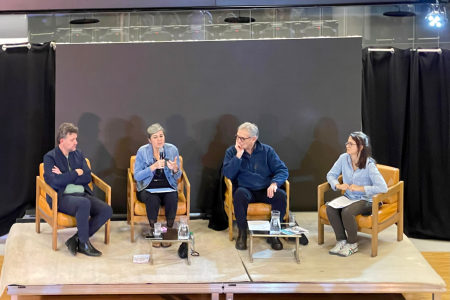
On Thursday June 12, 2025, the Crash team was delighted to welcome Neve Gordon and Nicola Perugini, for a conference entitled " Human shields. When humanitarian law turns against war victims". This meeting was prepared and moderated by Fabrice Weissman and Hakim Chkam.
00:38 Presentation
03:27 Introduction
12:18 Human shields, attacks on hospitals, and the Gaza abyss
33:44 The Norm, the Law and the Protection of Hospitals in War Zones
57:05 Why should we still believe in the normative power of law in war situations?
01:01:36 Question 1: Wouldn’t social pressure be more effective than a legal ban?
01:11:29 Question 2: To what extent does the counterterrorism doctrine challenge the principles of distinction established by the Geneva Conventions?
01:21:37 Question 3: To what extent is the US-influenced approach of 'algorithmic governmentality' being applied in Gaza?
01:25:23 Question 4: What can we realistically expect from a ban, given that states can always find ways to circumvent legal provisions?
01:33:04 Question 5: How relevant is the comparison with the ban on landmines?
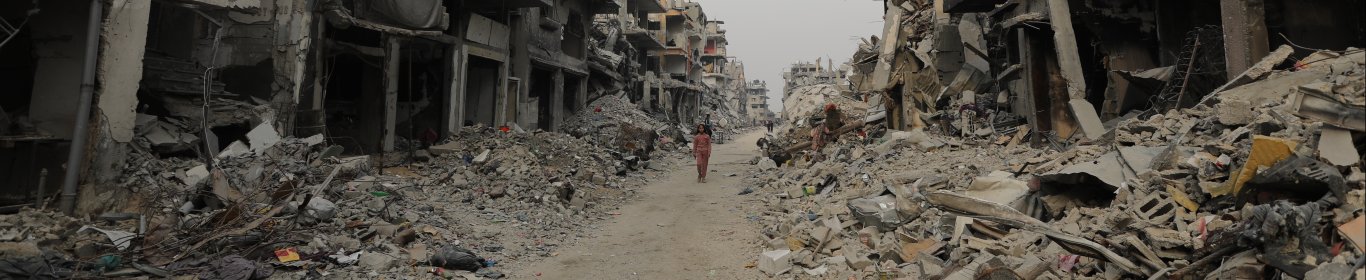
“Even war has rules”. This is the slogan brandished by MSF, the United Nations and the ICRC to protest against the bombing of health facilities and the massacre of civilians in Gaza and in many other conflicts. “Yes, war has rules”, retorts the Israeli army, but in this case it's Hamas that's violating them by using hospitals and the population as “human shields”. As such, the Israeli armed forces are not guilty of any crime in causing the “accidental” death of civilians, wounded and health workers in its fight against the perpetrators of the October 7 atrocities.
While not new, this line of reasoning is taken to extremes by the Israeli government, whose propaganda invokes international humanitarian law to justify its genocidal violence against the Palestinian population. As Neve Gordon and Nicola Perugini point out, international humanitarian law (IHL) does not offer unconditional protection to health facilities and non-combatants, especially when they are described as “human shields”. The latter can then be bombed, provided that “military necessity” justifies it and that “precautions” have been taken to avoid collateral casualties “excessive in relation to the military advantage anticipated”.
Under these conditions, isn't calling for respect for international humanitarian law to protest against the bombing of hospitals and civilians counter-productive? In practice, is IHL not the ally of the most powerful states, authorizing war violence against unarmed populations? To which extent does the consent of European states to the reversal of IHL against war victims in Gaza constitutes a turning point? How can we strengthen the normative framework protecting hospitals and civilians in conflicts, and increase the political cost of mass violence?
These are the questions we discussed on Thursday June 12 from 6.30pm with Neve Gordon and Nicola Perugini. Neve Gordon is former director of Physicians for Human Rights. He teaches international law at Queen Mary University of London. Nicola Perugini is Professor of International Relations at Edinburgh University. Both published in 2020: Human Shields. A History of People in the Line of Fire (University of California Press 2020).
References:
- Neve Gordon , Nicola Perugini, ‘Hospital Shields’ and the Limits of International Law Free, in European Journal of International Law, Volume 30, Issue 2, May 2019, Pages 439–463: https://academic.oup.com/ejil/article/30/2/439/5536724
- Neve Gordon , Nicola Perugini, Human Shields. A History of People in the Line of Fire (University of California Press 2020)
- Neve Gordon , Nicola Perugini, A Legal Justification for Genocide? July 17, 2024? https://jewishcurrents.org/human-shields-gaza-israel-a-legal-justification-for-genocide
To cite this content :
Neve Gordon, Nicola Perugini, “Human shields. When humanitarian law turns against war victims”, 12 juin 2025, URL : https://msf-crash.org/en/conferences-debates/human-shields-when-humanitarian-law-turns-against-war-victims
If you would like to comment on this article, you can find us on social media or contact us here:
Contribute MSF
Analysis
MSF
Analysis
Préface à l'ouvrage "Le Livre noir de Gaza"
10/07/2024Le Livre noir de Gaza est un ouvrage paru le 4 octobre 2024 aux Éditions du Seuil. Il recense autant que possible les faits qu’ont pu établir les ONG internationales, palestiniennes et israéliennes, depuis le début de la guerre. Il est construit à partir de leurs rapports, d’enquêtes d’experts et d’articles de presse, sélectionnés et introduits par la spécialiste du Moyen-Orient Agnès Levallois, avec les contributions inédites de consultants indépendants et responsables d’ONG. La préface a été rédigée par Rony Brauman.
 Conference
Ukraine-Gaza, exchange of views
12/03/2024 - 06:30 PM 08:30 PMOn Tuesday, December 3, 2024, the Crash team was pleased to welcome Julia Grignon, Jean-François Corty and Rony Brauman for a conference-debate to mark the publication of the latest issue of Alternatives Humanitaires magazine: “Ukraine-Gaza, cross-perspectives”, in which humanitarian practitioners and observers share their analyses.
 Interview
Rony Brauman : « Nous sommes, à Gaza, face à une situation génocidaire »
11/08/2024Guerres au Proche-Orient, putschs au Sahel, reflux démocratique global… Celui qui présida Médecins sans frontières de 1982 à 1994 porte un regard pessimiste sur le devenir du monde. Un entretien de Jeune Afrique.
Past events
 Conference
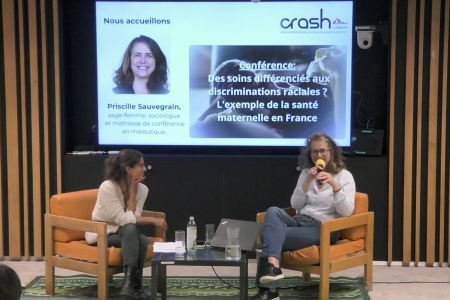
From differentiated care to racial discrimination? The example of maternal health in France
09/19/2024 - 08:30 PM 10:30 PMOn Thursday 19 September 2024, the Crash team was delighted to welcome Priscille Sauvegrain for a conference on medical practices in maternal health in France and the role played by racial categories. This meeting, prepared with Caroline Izambert, was moderated by Judith Soussan.
 Conference
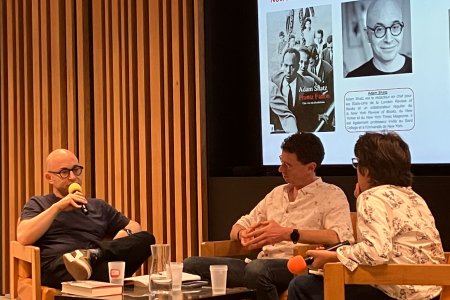
Frantz Fanon, by Adam Shatz
06/27/2024 - 08:00 PM 10:00 PMOn 27 June 2024, the Crash team welcomed the journalist and essayist Adam Shatz for a lecture on Frantz Fanon. The conference was prepared and moderated by Caroline Izambert and Michaël Neuman.
 Conference
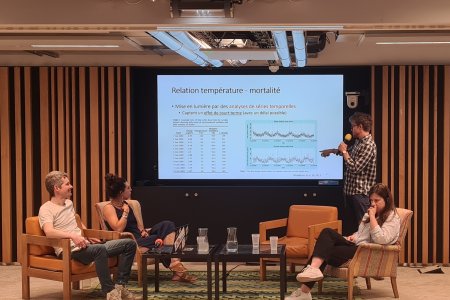
Heatwaves: what mortality rates and what are the challenges for MSF?
06/06/2024 - 08:30 PM 10:30 PMOn 6 June 2024, MSF France's Green Team and the Crash team will be delighted to welcome Lana Whittaker, Kévin Jean and Aina Roca Barceló for a conference on heatwaves. The conference, prepared with Judith Soussan and Cyril Bousquet, was moderated by Fabrice Weissman and Alexandre Chaudonneret.
 Conference
Rohingya refugees: what can MSF do?
04/04/2024 - 08:30 PM 10:30 PMOn Thursday, April 4, 2024, the CRASH team welcomed Emilie Medeiros, Eloïs Voisin and Raphaël Torlach for a conference/debate on the situation of the Rohingya refugees in Bangladesh. This conference was prepared and moderated by Michaël Neuman.
 Conference
Attestation, an experiment of mass obedience
02/29/2024 - 07:00 PM 09:00 PMOn Thursday 29 February 2024, we welcomed sociologists Théo Boulakia and Nicolas Mariot, the authors of "L’Attestation. Une expérience d’obéissance de masse, printemps 2020". This conference was prepared and moderated by Elba Rahmouni and Marc Le Pape.
 Conference
Migratory deaths, missing persons and their identification
01/11/2024 - 07:30 PM 09:30 PMOn Thursday 11 January 2024, the CRASH team welcomed artist Rachid Koraïchi, forensic anthropologist Jose-Pablo Baraybar and anthropologists Filippo Furri and Silvia Di Meo for a round table discussion on missing and dead migrants and their identification. This conference, prepared with Michaël Neuman, was moderated by Sarah Chateau.