
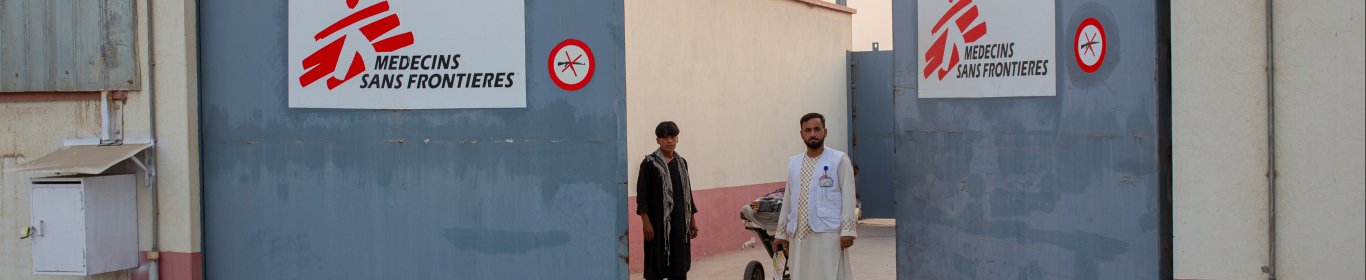
Acceptance: Beware Danger!
Fabrice Weissman

A political scientist by training, Fabrice Weissman joined Médecins sans Frontières in 1995. First as a logistician, then as project coordinator and head of mission, he has worked in many countries in conflict (Sudan, Ethiopia, Eritrea, Kosovo, Sri Lanka, etc.) and more recently in Malawi in response to natural disasters. He is the author of several articles and collective works on humanitarian action, including "In the Shadow of Just Wars. Violence, Politics and Humanitarian Action" (ed., London, Hurst & Co., 2004), "Humanitarian Negotiations Revealed. The MSF Experience" (ed., Oxford University Press, 2011) and "Saving Lives and Staying Alive. Humanitarian Security in the Age of Risk Management" (ed., London, Hurst & Co, 2016). He is also one of the main hosts of the podcast La zone critique.
The term “acceptance” became part of the humanitarian vocabulary in the late 1990s, with the publication of the first manuals and training programs dedicated to the security management of aid operations. It refers to one of three strategies proposed to humanitarian actors to reduce risks in violent environments: using passive protection measures (helmets, bulletproof vests, armoured vehicles, fortified compounds, etc.), deterring potential attackers through local or international armed forces, or eliminating threats by earning everyone’s appreciation (acceptance). But how does one become appreciated, tolerated, and accepted? Two approaches coexist: one, political, emphasises the importance of caring for one’s friends; the other, marketing-oriented, emphasises the need to cultivate an image as a “principled organization”—neutral, independent, and impartial.
"Acceptance (of MSF presence & work) is the key to build a proper security management for the MSF project. MSF shows respect for the cultural and Islamic values of the population. MSF points out the importance of its principles and quality health care on any given opportunity."
- MSF Afghanistan Security Guideline, 2022
"The first pillar of the ICRC’s security model is ‘acceptance’, a concept embedded in the ICRC’s DNA (…) Acceptance is fostered by adhering to the principles of impartiality and of independence. To be effective, these principles must be explained and applied consistently."
- CICR, 2021 Fiona Terry, Jean-Philippe Kiehl, Robert Whelan, and Tamás Szenderák, « Debunkerising Acceptance: a view from the ICRC », Global Interagency Security Forum (GISF), Achieving Safe Operations through Acceptance: challenges and opportunities for security risk management, 2021, available at: https://gisfprod.wpengine.com/wp-content/uploads/2021/12/Debunkerising_Acceptance_a_view_from_the_ICRC.pdf.
"MSF OCA and its staff’s adherence to core humanitarian principles is instrumental in gaining acceptance by all relevant stakeholders in the context. Whilst acceptance remains the dominant security strategy, protective measures may also be deployed when appropriate."
- MSF Operational Center Amsterdam, General Safety and Security Policy
"The concept of acceptance has long been the cornerstone of the humanitarian security approach. The core humanitarian principles of humanity, neutrality, and impartiality underpin acceptance and provide the basis for warring parties to accept humanitarian action in situations of armed conflict."
- OCHA, 2011 OCHA, To Stay and Deliver. Good Practice for Humanitarians in Complex Security Environments, 2011, available at: https://www.unocha.org/publications/report/world/stay-and-deliver-good-practice-humanitarians-complex-security-environments-enar.
The Political Origins of Acceptance (Taking Care of Friends)
The 1990s were marked by a significant expansion of international aid operations in conflict zones, one consequence of which was an increase in the absolute number of humanitarian workers injured, killed, or kidnapped — particularly in the Balkans, the Caucasus, and Central Africa in the Great Lakes region.See Fabrice Weissman, “Violence Against Aid Workers: The Meaning of Measuring,” in Michaël Neuman and Fabrice Weissman (eds.), Saving lives and Staying Alive: Humanitarian Security in the Age of Risk Management, Paris, CNRS Editions, 2016, pp. 105–133, available at: https://msf-crash.org/en/secourir-sans-perir-la-securite-humanitaire-lere-de-la-gestion-des-risques/2-theories.At the initiative of European and American donors, humanitarian agencies were encouraged to professionalise their security management, develop training programs, and draft manuals. One of the most well-known manuals is Good Practice Review No. 8 (GPR8), published by the Overseas Development Institute (ODI), a London-based think tank that is highly influential in the aid sector.
The first edition of the GPR8, ‘Operational Security Management in Violent Environments’, was published in June 2000.Koenraad Van Brabant, Operational Security Management in Violent Environments, HPN Good Practice Review 8, June 2000, available at: https://gisf.ngo/wp-content/uploads/2014/09/0368-van-Brabant-GPR-8-Operational-security-management-in-violent-environments.pdf It was written by Koenraad Van Brabant, an anthropologist by training. In this first version, the GPR8 laments that aid workers too often tend to hole up in militarised compounds from which they only venture out in armoured vehicles (protection), under the close guard of peacekeeping forces or local militias (deterrence). Although these measures are sometimes unavoidable, they have the effect of isolating aid workers from the populations they seek to help. This is why the first edition of the GPR8 emphasises it is preferable to pursue a “strategy of acceptance” aimed at neutralising or reducing hostility towards humanitarian workers.
They must break free from a “besieged mentality,”GPR8, 2000, p. 57. step out of their armoured vehicles, and “invite to ‘tea’”GPR8, 2000, p. 61. the authorities and the local population in order to better understand their expectations and interests: to what extent do relief efforts strengthen or, on the contrary, weaken the ruling authorities? Do these efforts alter the political and military balance of power? Are they in conflict with the objectives pursued by certain groups (population displacement, blockades, colonisation, scorched earth, etc.)? Who are the individuals and groups excluded from aid projects, and how are they likely to react?GPR8, 2000, pp. 40–43.According to the first edition of the GPR8 (2000), these questions should guide the adaptation of relief operations to the interests of the forces involved, even if this means that “resources are allocated not strictly according to need, but in a way which may facilitate the overall operation.”GPR8, 2000, p. 58. In other words, “acceptance is about making more friends, protection about sheltering at a distance, and deterrence about intimidating your enemies.” However, this first manual warns, acceptance must never be taken for granted: “it has to be won and actively maintained.”GPR8, 2000, p. 58. Moreover, it cannot be obtained from all armed groups: some may become “allies,” while others will remain “threats.”GPR8, 2000, pp. 58-59.
The marketing shift towards acceptance (managing one’s image)
In the second and third editions of the GPR8, published in 2010 and 2025 respectively, this political approach to risk gives way to a marketing approach that reduces acceptance to a matter of image and perception. To ensure their safety, relief organisations must above all be perceived as neutral, independent, and impartial, “through good works and adherence to humanitarian principles,” states the 2010 edition of the GPR8.GPR8, Revised Edition 2010, p. 57 (“Achieving broad acceptance from communities, through good works and adherence to humanitarian principles”), available at: https://odihpn.org/wp-content/uploads/2010/11/GPR_8_revised2.pdf This position is reiterated in the 2025 edition, which asserts:
“The humanitarian principles of neutrality, impartiality, and independence are directly linked to security by influencing how local communities and warring parties perceive aid organisations and their staff. These perceptions can make or break an organisation’s acceptance (a measure by which the organization is recognized in a given area, and its work appreciated or at least tolerated). It is chiefly through establishing acceptance that a humanitarian organization can gain and maintain secure access to work in high-risk areas.”GPR8, Revised Third Edition 2025, p. 37, available at: https://odihpn.org/en/publication/humanitarian-security-risk-management/This has been the prevailing wisdom in the aid sector for at least twenty years, as evidenced by the quotes cited at the beginning of this article.
This redefinition of acceptance in terms of perception (rather than interest) coincides with a shift in how aid actors view the dangers threatening them. According to the 2010 edition of the GPR8, the hostility of certain governments and armed groups towards international aid agencies stems from a misunderstanding: they are (wrongly) perceived as agents of Western states’ foreign policy.
"In some parts of the world, the general acceptance of (Western) aid agencies has become more problematic because they are now being seen as instruments of Western foreign policy or Western values. This has been the case most prominently in places where the ‘war on terror’ has played out (Iraq, Afghanistan, parts of Pakistan). But it can also be observed elsewhere: the Sri Lankan government has long harboured a deep suspicion of foreign aid agencies (including the UN) in relation to its conflict with the Tamil Tigers; the Burmese authorities were suspicious of the influence of foreign aid agencies following Cyclone Nargis; and the Mugabe government in Zimbabwe has periodically challenged the presence and programming of Western aid agencies. In Sudan, government suspicion toward and restrictions on international agencies increased following the International Criminal Court’s indictment of President Omar al-Bashir in 2009." GPR8, 2010, p. 66.In fact, the end of the Cold War ushered in a new era of political and military intervention by the UN and liberal democracies in conflicts.See François Jean (ed.), Face aux crises…, Paris, Hachette, 1993; Fabrice Weissman (ed.), “In the Shadow of ‘Just Wars’. Violence, Politics and Humanitarian Action”, Paris, Flammarion, 2003. The first Gulf War in 1991 was followed by a proliferation of international armed interventions under the UN flag in the Balkans and Africa (Mozambique, Rwanda, Somalia, Liberia, Sierra Leone, Angola, Ivory Coast, DRC). In 1999, NATO bombed and occupied Kosovo, which became a UN protectorate. In response to al-Qaeda’s attacks on the World Trade Centre in 2001, the United States invaded Afghanistan and then Iraq two years later. During the 1990s and 2000s, France deployed its military to Rwanda, Côte d’Ivoire, the DRC, and the Central African Republic; the United Kingdom to Sierra Leone; and Australia to Timor-Leste.
These interventions shared the common feature of being justified by considerations that were both humanitarian (securing aid operations, protecting populations, defending human rights, promoting democracy, etc.) and security-related (preserving international peace and stability, and, following September 11, 2001, combating terrorism). These were accompanied by the roll-out of major aid operations, carried out by UN agencies and NGOs, more than 90% of which were funded by Western countries, led by the United States. From the perspective of liberal democracies and the UN, humanitarian organisations were a “force multiplier,” to use the phrase coined by U.S. Secretary of State Colin Powell during the 2001 invasion of Afghanistan. Through their actions, they helped the UN or Western armies win the war or consolidate peace.
This strategic alignment between liberal democracies and international aid agencies was a boon for humanitarian organisations, whose financial and human resources expanded considerably. But the narrative linking them to the interventionism of the United Nations and Western governments made them uncomfortable. They feared being associated with Western or UN armed forces and being targeted by their enemies as a result.
These fears intensified following the suicide bombing of the UN headquarters in Baghdad on August 19, 2003, which claimed 22 lives, including Sergio Vieira de Mello, the UN High Commissioner for Human Rights and head of the UN Mission in Iraq. This was the first time since the 1948 assassination of a senior UN official by a Zionist armed group in Palestine that the United Nations had been directly targeted by an attack.In 1948, Folke Bernadotte, the UN mediator in Palestine, was assassinated in Jerusalem by an armed Zionist group (Lehi). In 1961, Dag Hammarskjöld, the UN Secretary-General then on a mission to Congo, died in a plane crash whose circumstances remain unexplained. According to a UN investigation, his plane was shot down. Two months later, the International Committee of the Red Cross (ICRC) office in the Iraqi capital was targeted by a suicide ambulance, whose explosion killed 12 people. The following year, the director of Care International in Iraq, Margareth Hassan, was kidnapped and executed by an armed group demanding the withdrawal of British troops from the country.A British, Irish, and Iraqi national who had lived in Iraq for 30 years, Margareth Hassan was known for her commitment to the Iraqi people. After her abduction, numerous Iraqi political and religious leaders mobilised to demand her release. On June 2, 2004, five members of MSF Holland were killed in Afghanistan when their clearly marked vehicle was attacked in Badghis province. A Taliban spokesperson claimed responsibility for the attack, telling Reuters: “We killed them because they worked for the Americans against us using the cover of aid work. (…) We will kill more foreign aid workers.”Afghanistan: Aid Workers Under Fire | Human Rights Watch, 4 juin 2004, https://www.hrw.org/news/2004/06/04/afghanistan-aid-workers-under-fire.
For MSF and many aid agencies, this tragedy illustrated the disastrous consequences of the “blurring of lines between military and humanitarian action.” The humanitarian rhetoric of Western armies, their involvement in aid activities similar to those carried out by NGOs, and more broadly the aid system’s participation in the stabilisation of Afghanistan under the auspices of the UN and NATO explained why humanitarian organisations have become targets: “Aid is no longer perceived as an impartial action, which endangers the lives of volunteers and reduces access to populations in distress,” stated MSF upon leaving Afghanistan in July 2004.MSF, press release, “After 24 years of presence, MSF withdraws from Afghanistan,” July 28, 2004, available at: https://www.msf.fr/actualites/apres-24-ans-de-presence-msf-se-retire-d-afghanistan
In this case, it turns out that the Taliban were not responsible for the attack that claimed the lives of our colleagues. The ambush on our colleagues’ vehicle was orchestrated by a local commander opposed to the central government and eager to demonstrate his capacity to cause disruption. Their murder was therefore not linked to the “military-humanitarian confusion” but to power struggles between rival factions allied with the international coalition — and to the political repercussions of the murder of foreigners in this context.See Xavier Crombé with Michiel Hofman, “Afghanistan: A Negotiated Return,” in Claire Magone et al. (eds.), Acting at Any Cost? Humanitarian Negotiations: The Experience of Doctors Without Borders, Paris, La Découverte, 2011, pp. 65–91, available at: https://msf-crash.org/fr/agir-tout-prix-negociations-humanitaires-lexperience-de-msf/i-histoires-courtes
Nevertheless, the threats made by the Taliban in 2004 were very real at the time. In March 2003, an ICRC delegate was assassinated on the Taliban’s orders, as was a UNHCR representative eight months later. In disarray and no longer controlling any territory, the Taliban sought to sow chaos behind government lines and, through their false claims, to portray themselves as having military significance they did not possess. From their perspective, a good humanitarian worker was a dead humanitarian worker. Through the services they provided to the population and the vast sums they spent in the local economy, humanitarian actors de facto supported the war effort of the national and international forces that had driven the Taliban away from power. Even more so since no humanitarian organisation, not even MSF, protested the killing by coalition forces and their Afghan allies of hundreds of Taliban prisoners of war, in government prisons or during their transfer in hermetically sealed containers.Ibid. The Taliban viewed the humanitarian presence as running counter to their interests — much as jihadist groups in Iraq saw little benefit in humanitarian deployments, except when they kidnapped expatriates and negotiated their release for ransom, or executed them in highly publicised killings as part of a strategy of terror.
This political dimension of insecurity — the incompatibility between the Taliban’s war aims in the early 2000s and the actions of humanitarian organisations, including MSF and the ICRC — was completely overlooked by the principled “acceptance” approach, which attributed the dangers to a tragic misunderstanding fuelled by “military-humanitarian confusion.” Ignoring the recommendations of the first edition of the GPR8, most humanitarian actors did not question how their actions effectively alter the political-military balance of power in favour of the coalition forces and their Afghan allies... Their priority was different: to distinguish themselves from “the West” through communication campaigns cultivating their image as a “principled” organization.
In Afghanistan, this approach led MSF to redouble its efforts to present itself publicly as a “neutral, independent, and impartial” organisation. Nevertheless, it was by taking the Taliban’s interests into account that MSF re-established dialogue with them a few years later.See Xavier Crombé, op. cit. Starting in 2006, the Taliban began to recapture territory and came to view aid workers as more useful to them alive than dead, particularly for the provision of medical care for fighters and civilians within their area of influence. In 2009, MSF resumed operations in Afghanistan, in Helmand Province — largely under the control of the armed opposition — and in a Kabul suburb hosting many displaced people. But the political approach on which MSF based its resumption of negotiations with the Taliban was completely obscured by its discourse: both publicly and internally, MSF asserts that if the organisation is now “accepted” and safe, it is because it is doing “good work” and “upholding principles” by engaging with all parties to the conflict.
This fictional narrative ultimately influenced the security assessments of operational leaders. According to retrospective analyses conducted by MSF, the belief in the protective power of principles and acceptance was one of the reasons why MSF underestimated two major risks: the hostility of certain pro-government factions towards its strategy of engagement with the Taliban, which resulted in the U.S. military’s bombing of the Kunduz hospital in 2015 (32 dead, including 13 MSF staff members and 10 patients); and the Islamic State’s hatred of foreigners and Shia populations, which led to the attack on the Dasht-e-Barchi maternity ward in Kabul in 2020 (24 dead, including 16 mothers, a MSF midwife, and two young children).
The Dangers of the marketing Approach to Acceptance
The success of the marketing approach to acceptance stems from the fact that it perpetuates the fiction that humanitarian action can be kept outside the political and military spheres. However, regardless of their intentions and how they interpret their principles, aid agencies introduce significant resources into conflicts, which may reinforce or threaten existing power structures.See Fabrice Weissman, “Crisis and Humanitarian Containment,” MSF-CRASH, Dec. 19, 2023, available at https://msf-crash.org/en/humanitarian-actors-and-practices/crisis-and-humanitarian-containment This is particularly evident in refugee or internally displaced persons (IDP) camps, which can serve as instruments for controlling populations deemed dangerous (as in Sri Lanka in 2009 or in Nigeria since the mid-2010s, where the military used humanitarian aid to organise the internment of populations forcibly evacuated from rebel-held areasSee, for example, Fabrice Weissman, “Sri Lanka: Amid All-Out War,” in Humanitarian Negotiations Revealed: The MSF Experience, edited by Claire Magone, Michaël Neuman, and Fabrice Weissman, Paris, Éditions La Découverte, 2011, available at: https://msf-crash.org/fr/agir-tout-prix-negociations-humanitaires-lexperience-de-msf/i-histoires-courtes and Vincent Foucher, Fabrice Weissman, “La fabrique d’une ‘crise humanitaire’. Le cas du conflit entre Boko Haram et le gouvernement nigérian (2010-2018)” Politique africaine, 2019/4, No. 156, pp. 143–170, available at: https://shs.cairn.info/revue-politique-africaine-2019-4-page-143?lang=fr). In other circumstances, camps can serve as sanctuaries for armed or criminal groups exercising varying degrees of control over aid distribution (as was the case with genocidal militias in Rwandan refugee camps in Zaire in the late 1990sSee Bradol, Jean-Hervé, and Le Pape, Marc, “Humanitarian Aid, genocide and mass killings: Médecins Sans Frontières, the Rwandan experience, 1982-97” Paris, Manchester University Press, 2017, 280 pp., available at: Humanitarian aid, genocide and mass killings. https://msf-crash.org/en/war-and-humanitarianism/humanitarian-aid-genocide-and-mass-killings-medecins-sans-frontieres). Outside the camps, humanitarian aid is a valuable resource for governments or armed groups seeking to care for and feed their fighters, administer territories, and meet the social expectations of their populations. States such as South Sudan, for example, delegate all their redistributive functions (health, education, infrastructure, etc.) to the aid system, reserving state revenues for the enrichment of the ruling oligarchy and its clientele.See UN, « Soudan du Sud : l’ONU dénonce une corruption systémique et une prédation des élites », September 16 2025, https://news.un.org/fr/story/2025/09/1157477
Beyond the services they provide to the population, humanitarian actors represent a significant source of revenue for authorities and local leaders, through taxes, exchange rate controls, or, more prosaically, embezzlement, theft, looting, or hostage-taking. Aid agencies inject significant liquidity into the local economy in the form of salaries, rent, service contracts, and local purchases. These expenditures have a ripple effect on the local economy, to the point of contributing to the creation of genuine urban hubs in some countries. Competition to capture the humanitarian rent can itself be a source of insecurity, as in Somalia (where many security incidents are linked to the negotiation of labour and service contracts).
Finally, aid agencies act as opinion shapers, influencing how governments and armed groups are perceived within local societies and the rest of the world. This is, in fact, the only political dimension explicitly addressed by the marketing approach of the last two editions of the GPR8, which advise humanitarian actors against speaking out on violations of human rights and humanitarian law so as not to undermine “acceptance.”The guide recommends that journalists be cautious about letting field staff have the final say on public communications. “The pursuit and preservation of acceptance may require that agencies stay silent about humanitarian or human rights abuses. Speaking out may create security risks on the ground, or may lead to the agency’s expulsion. (,,,) A good organisational policy would be never to make any public statement about a particular situation without first having received the go ahead from field-based colleagues” (GPR8-2010, p. 68).
Believing themselves to be safe so long as they are perceived as neutral, independent, and impartial, humanitarian actors refrain from examining their role in the political economy of conflicts, thereby overlooking the real reasons why they are tolerated and accepted. In doing so, they run a twofold risk: first, of failing to recognise the moment when they become more useful dead than alive to certain actors in the conflict; and second, of overlooking the moment when their contribution to the political economy is such that they become more useful to the criminal forces that “accept” them than to the oppressed populations they seek to help.
To cite this content :
Fabrice Weissman, “Acceptance: Beware Danger!”, 29 juin 2026, URL : https://msf-crash.org/en/acceptance-beware-danger
If you would like to comment on this article, you can find us on social media or contact us here:
Contribute Manon Massiat/MSF
A to Z
Manon Massiat/MSF
A to Z
Humanitarian corridors: negotiated exceptions at risk of manipulation
09/01/2025Frequently portrayed as tools to enable access in wartime, humanitarian corridors in fact reveal the ambiguities and limits of contemporary humanitarian action. Through a critical analysis this article questions the effectiveness, neutrality, and political implications of such mechanisms, which, under the guise of protection, may also serve military or diplomatic agendas.
 Pierre Fromentin/MSF
A to Z
Pierre Fromentin/MSF
A to Z
Armed escorts - neither for nor against
09/01/2025Caught between humanitarian commitment to vulnerable populations and security concerns, the issue of the use of armed escorts by humanitarian organisations raises some fraught questions. Médecins Sans Frontières has adopted this practice, controversial as it is, in a number of contexts throughout its history. Can we resort to this type of protection without compromising our neutrality? Are MSF's image and the very safety of its teams threatened by being so close to armed actors?
 Hareth Mohammed/MSF
A to Z
Hareth Mohammed/MSF
A to Z
Deconfliction: an effective protection arrangement?
09/01/2025As deconfliction has become a central tool in civil-military relations within conflict zones, this concept — rooted in military jargon — raises serious questions about its actual effectiveness. Michaël Neuman examines the origins, uses, and ambiguities of these mechanisms meant to protect humanitarian actors, while highlighting the risks of replacing legal guarantees with limited contractual arrangements.