
How do you explain the spectacular increase in serious security incidents recorded by MSF France in recent years?
Fabrice Weissman

A political scientist by training, Fabrice Weissman joined Médecins sans Frontières in 1995. First as a logistician, then as project coordinator and head of mission, he has worked in many countries in conflict (Sudan, Ethiopia, Eritrea, Kosovo, Sri Lanka, etc.) and more recently in Malawi in response to natural disasters. He is the author of several articles and collective works on humanitarian action, including "In the Shadow of Just Wars. Violence, Politics and Humanitarian Action" (ed., London, Hurst & Co., 2004), "Humanitarian Negotiations Revealed. The MSF Experience" (ed., Oxford University Press, 2011) and "Saving Lives and Staying Alive. Humanitarian Security in the Age of Risk Management" (ed., London, Hurst & Co, 2016). He is also one of the main hosts of the podcast La zone critique.
Since 2009, Médecins Sans Frontières (MSF) has been recording events affecting the physical security of its staff deployed in the field in an online database called SINDY. There are a number of limitations to this quantification exerciseMichaël Neuman, Fabrice Weissman, "Chapter 2: Theories", Saving Lives and Staying Alive: Humanitarian Security in the Age of Risk Management, 29 mars 2016: https://msf-crash.org/en/secourir-sans-perir-la-securite-humanitaire-lere-de-la-gestion-des-risques/2-theories the case definitions are ambiguous; the systematicity with which events are recorded varies from one section to another, from one country to another, from one period to another; these statistics add together, within broad categories, events of widely differing significance and consequences; etc.
These limitations are less pronounced for the category of "severe incidents", which are recorded more exhaustively and on the basis of a more precise definition, yet still open to interpretation. According to the common nomenclature used by MSF security focal points, these are "an event that results in serious harm to individuals (e.g. severe injury, death, psychological trauma), major financial loss (mor than €100,000) and/or a significant operational disruption (such as project suspension or closure)".
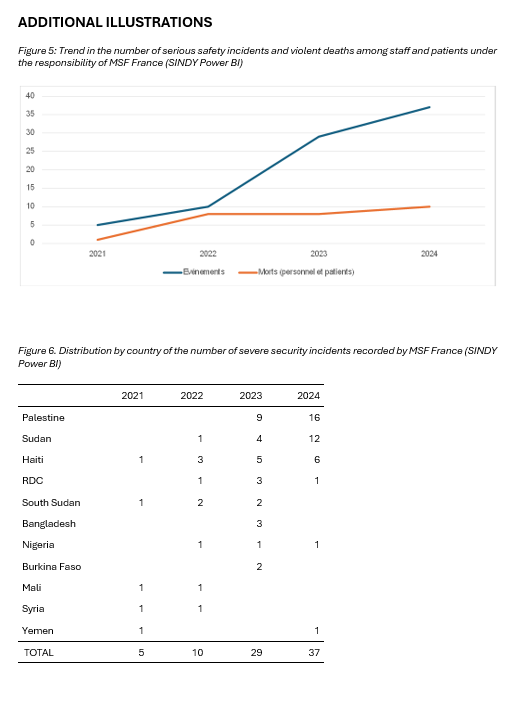
The SINDY report recently compiled by the safety referents and the International Office of MSF shows a sharp increase in severe security incidents recorded by MSF France over the last two years (illustrations 1 & 5). Whereas in 2021, only 5 severe events were recorded, and one death reported, 37 severe events were recorded in 2024, resulting in the death of 10 people. How can this trend be explained?
Figure 1: Trend in the number of serious security incidents and violent deaths among staff and patients under the responsibility of MSF France (SINDY Power BI)
Firstly, there does not appear to be a widespread increase in insecurity, as 90% of serious incidents occurred in just three countries - Haiti, Palestine and Sudan (illustrations 2 & 6).
Sudan and Palestine are responsible for the sharp increase recorded since 2023. This is not linked to an exceptional increase in our exposure surface (number of projects and staff deployed in dangerous areas), but to the increase in dangers and risk-taking. In fact, according to the incidence indicator calculated by MSF security focal points (the total number of incidents per 10,000 "Full Time Equivalents" – i.e. posts – per year)This is an imperfect indicator (but it has the merit of existing). The numerator and denominator are not expressed in the same units. One quantifies incidents, the other people. A more rigorous indicator could relate the number of people injured, killed, raped or tortured to the average number of full-time equivalents in the field., the incidence of severe events in 2024 is 8 times higher than the average in Sudan and 15 times higher than the average in Palestine. The average corresponds approximately to the incidence of severe events recorded in the Democratic Republic of Congo.
Figure 2. Distribution by country of the number of severe security incidents recorded by MSF France (SINDY Power BI)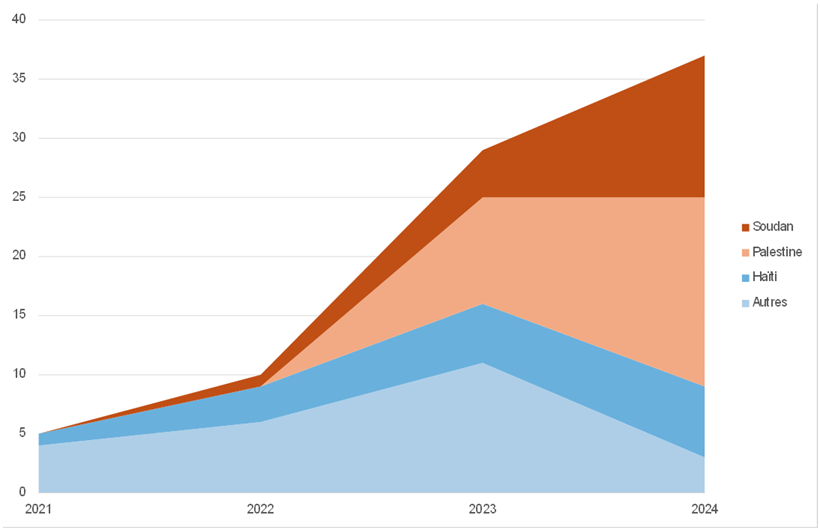
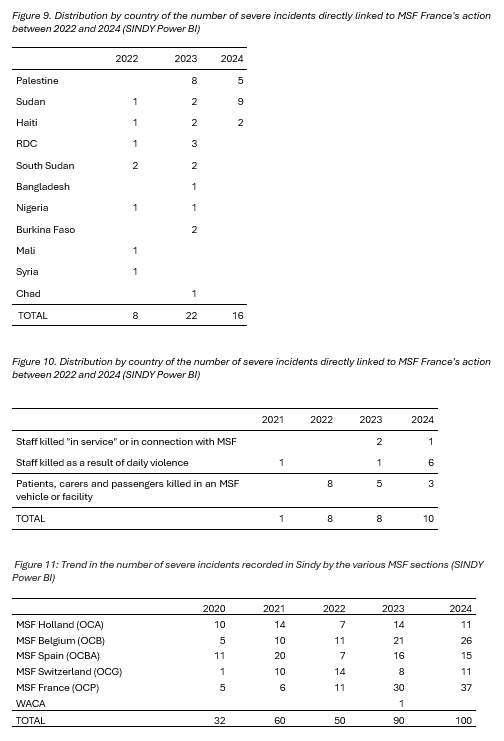
The SINDY database includes in the "severe incidents" category violence related to MSF relief operations, but also violence suffered by our staff in their daily lives, not directly related to their workAccording to the nomenclature: "an event that does not directly affect MSF (e.g. an incident related to the private lives of staff outside working hours)".(see illustrations 8 & 9). This "private" violence accounts for 21 of the 37 serious incidents recorded in 2024 (i.e. 3/5):
-
In Palestine, 11 out of 16 incidents involved the assassination or arrest of MSF staff in their homes or during personal travel.
-
In Haiti, 4 out of 6 incidents involved kidnappings (2) and shootings (2) in the home or in the street.
-
In Sudan, 3 out of 12 incidents are linked to the prevailing insecurity created by the Rapid Support Forces (RSF) and Arab militias.
Only 16 events out of 37 (2/5) occurred in the context of MSF France's relief operations. If we limit ourselves to this category ("incidents linked to MSF"), we can see that all the serious incidents recorded in 2024 (and no longer 90%) are concentrated in Palestine, Sudan and Haiti. Their increase is also less spectacular: their overall number falls between 2023 and 2024, but remains twice as high as in 2022. There are twice as many incidents linked to MSF operations in Sudan as in Palestine. While in Palestine more "private" violence was recorded than work-related violence (MSF protects?), the opposite was true in Sudan (MSF exposes?). Finally, of the 16 serious incidents directly related to relief operations, 13 (80%) involved attacks on health facilities or ambulances (see illustration 3).
Figure 3. Brief description of the 16 severe incidents directly linked to MSF France's operations in 2024 (SINDY Power BI)
Deaths among our staff are not increasing in the same proportions as the number of serious incidents (see illustration 10). The death of local or international staff in the course of their duties remains exceptional. The last two tragedies in this category were :
-
The machine-gunning by jihadist groups of an MSF car in Burkina Faso, which killed 2 people in 2023 ;
-
The assassination by the Israeli army of a physiotherapist accused of being a member of Islamic Jihad in Palestine, the only MSF employee killed "on duty" in 2024 (since he was murdered on his way from home to the clinic) but "unconnected with MSF's work".
In 2024, there were also 3 short-term kidnappings of local staff away from their place of work (2 in Haiti and 1 in Nigeria). And around thirty arrests by the police, some of them lengthy and accompanied by ill-treatment, but not always included in the list of serious incidents (such as that of an MSF liaison officer in Burkina Faso).
Comparison between MSF sections is difficult because of differences in the interpretation of case definitions and in the systematicity of recording, in particular severe incidents affecting our staff in their daily lives (for instance, MSF Belgium only records incidents "without any direct link with MSF" which haved resulted in violent death). Be that as it may, the available data show (cf. illustrations 4 & 11):
-
A doubling in the total number of incidents registered between 2020 and 2021, mainly driven by MSF Switzerland (OCG, not linked to specific contexts, more like an improvement in registration) and MSF Spain (OCBA, 12 incidents in West Africa).
The number doubled again from 2023, driven by the MSF France (OCP) and Belgium (OCB) incidents in Palestine. In 2024, Paris accounted for more than a third of all severe safety events recorded in the MSF movement, an over-representation which is partly explained by the recording of all serious incidents affecting our staff in their daily livesOnce again, interpreting these data is complicated. Sociologist Christine Fassert has shown, for example, how the criteria used to assess the performance of the various european air traffic control agencies have changed over time. In the early 1990s, the agencies judged to be the most efficient were those that reported the fewest incidents. Then, gradually, the evaluation criteria were reversed and the agencies judged to be the most efficient became those that reported the most incidents - the number of incidents reported being synonymous with rigour and systematicity in safety management. This remark is not intended to sidestep the problem raised by the glaring differences between the number of serious events reported by MSF France and, to a lesser extent, MSF Belgique, and those of the other sections. It is an invitation to go into the details of the figures and how they are produced - and to supplement this approach by studying individual stories which often tell us much more about risk management than the bare figures..
Figure 4. Trend in the number of severe incidents recorded in Sindy by the various MSF sections (SINDY Power BI)

In a nutshell
MSF France has recorded a spectacular increase in the number of serious incidents over the last two years. This increase is due to three countries - Haiti, Sudan and Palestine - and more particularly the last two. It has more to do with violence committed against our staff in their daily lives than with attacks directly targeting MSF. Although the increase in the number of attacks directly targetting MSF is less spectacular, it is nonetheless very real: 8 in 2022, 22 in 2023, 16 in 2024, wtih 80% of carried out againts healthcare facilities or ambulances. They occurred in four types of circumstances:
-
The targeting of health facilities by the Israeli army in Gaza,
-
Targeting health facilities by the RSFs in Sudan,
-
Indiscriminate bombing by the Sudanese army,
-
Police attacks on ambulances carrying injured gang members in Haiti.
These attacks are linked to the exercise of the medical mission. Once a marketing slogan used by MSF a few years agoFabrice Weissman, Michaël Neuman, “Is aid work really more dangerous than ever? Flawed studies won’t tell us”, 15 avril 2016, URL : https://msf-crash.org/en/blog/war-and-humanitarianism/aid-work-really-more-dangerous-ever-flawed-studies-wont-tell-us, is "Medical Care Under Fire" becoming a reality today?

To cite this content :
Fabrice Weissman, “How do you explain the spectacular increase in serious security incidents recorded by MSF France in recent years?”, 16 mai 2025, URL : https://msf-crash.org/en/humanitarian-actors-and-practices/how-do-you-explain-spectacular-increase-serious-security
If you would like to comment on this article, you can find us on social media or contact us here:
Contribute Julien Rey
Op-ed
Julien Rey
Op-ed
Is aid work really more dangerous than ever? Flawed studies won’t tell us
04/15/2016Since the 1990s and the rise of conflicts in West Africa, Somalia, Chechnya, the former Yugoslavia and Africa's Great Lakes region, humanitarian organisations have been warning of greater insecurity for their staff. These observations are bolstered by surveys aimed at objectively quantifying violence against humanitarian workers.