
Who are the gravediggers of humanitarian law?
Rony Brauman

Medical doctor, specialized in tropical medicine and epidemiology. Involved in humanitarian action since 1977, he has been on numerous missions, mainly in contexts of armed conflicts and IDP situations. President of Médecins sans Frontières from 1982 to1994, he has taught at the Humanitarian and Conflict Response Institute (HCRI) at the University of Manchester (UK) and at Sciences Po Paris. He has published several books and articles, including "Guerre humanitaires ? Mensonges et Intox" (Textuel, 2018), "La Médecine Humanitaire" (PUF, 2010), "Penser dans l'urgence" (Editions du Seuil, 2006) and "Utopies Sanitaires" (Editions Le Pommier, 2000).
This article was initially published the 29th of April 2026, in the book « Gaza, un génocide colonial », by the author Colette Braeckman. Rony Brauman develops a critical reflection on the war crimes committed in Palestine, on the limits of humanitarian law as well as the complicity of Europe in the methodical erasure of Palestinians.
If we are to believe the Israeli government and its various supporters, the attack on October 7 came like a bolt from the blue, an unexpected outburst of criminal violence that can only be explained by anti-Semitic hatred. Everything was fine, then, until the “pogrom” of October 7 at 6:30 a.m., as Israeli life was apparently proceeding peacefully before being brutally interrupted by the savagery of a barbaric attack.
We must clear up any ambiguity from the outset: these were indeed crimes—war crimes, crimes against humanity—committed by Hamas that day; these were indeed acts of terrorism, and it certainly takes a great deal of hatred to commit such atrocities. These crimes call for punishment, and one can only hope that those responsible for this massacre will be brought before a criminal court. The leaders of Hamas could not have failed to foresee that Israel’s response would be ferocious, and they will have to answer—before history, certainly, and perhaps before a court of law—for this policy of courting disaster.
There is a “pre-October 7”
Nevertheless, these atrocities cannot justify the excessive violence of the Israeli reprisals, the onslaught of killings and destruction on an unprecedented scale in this now century-old conflict. October 7 is not, as we seem to forget, the starting point of the Israeli Palestinian conflict, the longest and final colonial war on the planet. Gaza is an occupied territory, and the withdrawal of Israeli settlements in 2005 did not change this reality: the fact that the wardens of this open-air prison are no longer inside it but all around it does not fundamentally alter that reality.
Israel controls the lives of Palestinians through currency, banking transactions, their movement with the (rare) entries and exits, the exploitation of groundwater, the constant overflight of drones, the navigation restrictions imposed on fishermen, the imposition of a strip of barren land along the separation barrier, and the importation of goods. In 2009, Israel saw fit to ban the import of sanitary pads and toilet paper. The same applies to medicines and medical equipment arbitrarily refused by the occupying authority, with consequences that require little imagination.
From the outset of the siege in 2006, the Israeli government announced its intention to “put the Palestinians on a diet,” in the words of Dov Weissglass, political advisor to the then-Prime Minister Ehud Olmert. Israel granted itself the right to calculate the individual caloric ration sufficient “to keep them from starving to death.” What was the rationale behind these purely vexatious measures, and in what way were they related to the security of Israelis? For nothing other than the desire to assert Israeli authority, to demonstrate to the population of Gaza that the withdrawal of the settlements in no way signified the end of colonial domination.
This policy went hand in hand with the humanitarian aid sent by the European Union to Gaza, highlighting not the colonial blockade but Israel’s benevolence. And this despite the fact that, according to a 2020 UN report, the attacks and the siege of Gaza have caused economic losses of over $16 billion since 2007,UN News, “UN report finds Gaza suffered $16.7 billion in losses from the siege and occupation,” November 25, 2020. https://news.un.org/en/story/2020/11/1078532thousands of deaths, and thousands of people injured or maimed.
The Right to Self-Defence
In such a context, to portray the attack of October 7 as a senseless act of aggression that occurred out of the blue, motivated by a deadly hatred of Jews, amounts to the crudest form of propaganda. The “right to defend oneself” put forward by Israel and all its allies, including France, belongs not to the Israelis but to the Palestinians, as it does to any occupied population. The people of Gaza were and remain prisoners of the Israelis, and it was not Jews but Israelis who were attacked on October 7. Attributing a “right to self-defence” to the occupier amounts simply to denying the reality of the occupation. Let us clarify here that this right to resist occupation obviously does not authorize the killing or abduction of civilians. Let us also recall that many colonial conflicts have seen such atrocities committed by anti-colonial nationalists.
2006, 2008, 2014, 2018, 2021—Gaza’s history has been punctuated by war, resulting in thousands of deaths and tens of thousands of Palestinian injuries. The vast majority of Palestinians, in Gaza as in the West Bank, have known Israelis—since the 1990s and even more so since the 2000s—only in the form of armoured vehicles, snipers, drones, settler attacks, checkpoints, and other acts of violence and humiliation. If there are still pockets of human contact between Israelis and Palestinians in the West Bank, Gazans under thirty perceive Israelis solely as a mortal threat. The humanitarian aid provided by kibbutz residents to sick Gazans cannot erase the reality experienced by the vast majority of Gaza’s inhabitants. The hatred mentioned above has no possible other explanation.
Aimé Césaire warned us that “colonisation works to decivilise the coloniser, to brutalise him in the fullest sense of the word, to degrade him, to awaken buried instincts in him, greed, violence, racial hatred, and moral relativism.” Aimé Césaire, Discours sur le colonialisme, Présence africaine, 1989, p. 11-12. How better to describe what real Zionism has done to Israelis?
Two years after October 7, the campaign of destruction continues to set ever more macabre records: children and women killed or maimed, journalists killed, daily death tolls, material devastation, humanitarian workers targeted, hospitals ravaged… More than ten thousand prisoners in Israeli prisons are being held, without trial and in appalling conditions. Dozens have died under torture.
The Hippocratic Oath trampled underfoot
The attitude of many Israeli doctors, and the positions of the Israeli Medical Association—which represents 95% of the country’s doctors—reflect the radicalisation of Israeli society. An article published by the leaders of Physicians for Human Rights Israel (PHRI), Neve Gordon, Guy Shalev, and Osama Tanous, “The Shame of Israeli Medicine,” The New York Review, May 31, 2025. https://www.nybooks.com/online/2025/05/31/the-shame-of-israeli-medicine/ a remarkable association of healthcare workers in Israel, describes the individual and institutional reactions of the medical community. Most healthcare workers have contributed to the mistreatment through their refusal to provide care, their acceptance of treating patients who are restrained and blindfolded, their statements aligned with deadly propaganda, their refusal to condemn the executions of Palestinian healthcare workers, and their approval of attacks on hospitals in Gaza. Nearly four hundred healthcare professionals have been detained by Israel since October 2023, and more than twenty have gone missing.
The authors of the cited article refer to a 1999 United Nations directive instructing doctors to refrain from returning a detainee to prison if a physical examination confirms allegations of mistreatment. This directive itself stems from the refusal of South African doctors to return political prisoners to detention after they were hospitalized in Johannesburg following a hunger strike in 1989. This position, the authors note, has served as a guide for healthcare providers facing such situations. It refers to the concept of the “black flag”, a term by which the Israeli army, following the Kfar Qassem massacre (1956), On October 29, 1956, an Israeli patrol tasked with enforcing a curfew killed forty-nine residents of this Arab village located in Israel. accepted that soldiers might refuse a manifestly illegal order. Hence the self-proclaimed title of “the world’s most ethical army,” as proclaimed by the army itself.
The methodical erasure
Without being fooled by this claim, it is clear that the violence unleashed on Gaza in response to the Hamas attack has reached an unprecedented level, not only in Israel but also in comparison with other wars, as evidenced by the figure of 90% civilian casualties. According to Israeli intelligence data, 9,000 Hamas fighters have been killed. If we estimate the number of Gazan deaths at 100,000—a conservative estimate that does not account for indirect deaths—the civilian casualty rate rises to 90%. A record matched only by the 1994 genocide of the Tutsis in Rwanda.
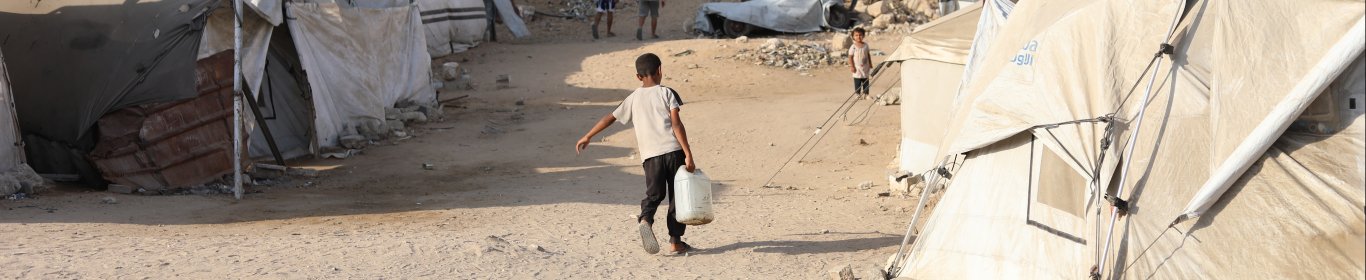
Gaza’s society has been reduced to overcrowded tent camps, with refugees displaced as many as twenty times, living under the constant hum of drones and the ever-present threat of bombardment, while epidemics spread. The total destruction of farmland (what threat, exactly, does this pose to Israel’s security?) and the blockade of aid have created the conditions for a famine that Israel’s “friends” continue to dismiss as either staged or as the responsibility of Hamas. Following the one-ton bombs—there is talk of 70,000 tons of bombs dropped on this tiny territory—came the bulldozers to complete the destruction of buildings, rip up the streets, and destroy the water pipes.
It is no surprise that the name Israel is now synonymous with mass crime, that it provokes rejection, even hatred. One of Netanyahu’s most famous unconditional supporters, Bernard-Henri Lévy, told Laurence Ferrari (CNews)https://www.youtube.com/watch?v=shfCnodFEdo Bernard-Henri Lévy - CNEWS Punchline: « Procès Sarkozy, Palestine, Gaza & Israël » (September 25, 2025) that if the reported facts were accurate, if a genocide were truly being committed in Gaza, hatred of Israel would be legitimate. One could not have put it better.
Humanitarian aid, the Israeli way
It was, in fact, to reassure its allies that the Israeli government, after banning humanitarian aid to Gaza, set up food distributions through an obscure “humanitarian foundation,” the Gaza Humanitarian Foundation (GHF). Four hundred aid sites had been established by UNRWA during the ceasefire; only four sites remained under the GHF, but that mattered little to Israel, since it was the image—not the reality—of these distributions that counted. More than 2,000 Palestinians lost their lives there, shot down by the mercenaries supposed to ensure the GHF’s security. In the long history of humanitarian aid, this Hunger Games-style massacre is unprecedented.
And as if to clarify its position on humanitarian aid, the Israeli government has decided to “suspend the registration” of 37 NGOs operating in the occupied territories—in other words, to ban them—while opening the door to other NGOs, primarily American and evangelical ones. The final crushing of Gaza, the construction site for a “riviera” and for settlers, is thus proceeding behind closed doors—a confinement made even more suffocating by the expulsion of the only foreign witnesses: the European NGOs. This ban applies to both Gaza and the West Bank, where the strategy of strangling the Palestinians continues with the explicit and acknowledged aim of emptying Palestine of its Palestinian inhabitants.
Europe’s culpable complicity
Is international humanitarian law (IHL) dead in Gaza? This is what we often hear, but this claim is debatable. While this carnage is of the most extreme kind, many other mass killings have taken place in the past—and continue to this day—without such a death certificate being issued. European, Soviet, and American imperial wars, as well as the crushing of uprisings and totalitarian regimes in the Global South, have produced mountains of corpses that must not be overshadowed by Israeli violence, any more than the contemporary wars in Sudan and the Democratic Republic of Congo. What characterises the genocidal war in Gaza—a war whose methods are gradually spreading to the West Bank, and what sets it apart from other conflicts currently taking place around the world—is the active consent of those who claim to defend the rule of law.
The airlift delivering ammunition from the United States was certainly essential for carrying out the bombings, but given American exceptionalism, we cannot expect Washington to uphold international humanitarian law. It is Europe—the place where international humanitarian law is developed and promoted—that must answer for this failure to act. Whatever moral credibility remained has now been lost, owing to the failure to impose even the slightest sanction, despite the fact that the EU-Israel Association Agreement could have been suspended and restrictive measures could have been adopted in the sporting, academic, cultural, and economic spheres, as has been done with Russia, Iran, and other states accused of serious human rights violations. Far from remaining passive, European countries have actively demonstrated their support by maintaining all their agreements and suppressing numerous expressions of solidarity.
Note the shift in perceptions: Israeli brutality is increasingly shocking to societies, yet the “Israeli exception” continues to prevail among governments. This political choice will remain a moral disaster, a mark of infamy. What moral weight can European rebukes of the atrocities committed by the criminal regime of the mullahs possibly carry when the atrocities committed by Israel’s genocidal regime are viewed as violence that, though excessive, remains somehow excusable?
In the absence of sanctions, the recent recognition of the State of Palestine by several European countries, however desirable it may be, remains ineffective. The crushing of all of Palestine continues, and the occupation plan currently being drafted in Washington attests that the imperial imagination is very much alive. The only encouraging development is that suspending the Association Agreement and imposing sanctions are no longer taboo subjects for European leaders—even though, let us recall, such measures were long portrayed, and still are by some, as manifestations of antisemitism. The Palestinians’ indisputable right to self-determination is not strengthened by this condemnation, which has remained purely rhetorical. To date, Spain alone, with both its government and its society acting in concert, has taken meaningful measures. Will other countries follow suit? Nothing suggests that they will.
To cite this content :
Rony Brauman, “Who are the gravediggers of humanitarian law?”, 29 avril 2026, URL : https://msf-crash.org/en/war-and-humanitarianism/who-are-gravediggers-humanitarian-law
If you would like to comment on this article, you can find us on social media or contact us here:
Contribute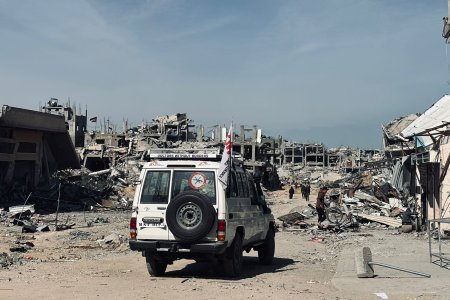 Nour Alsaqqa
Video
Nour Alsaqqa
Video
The Creation of a Closed-Off Zone in Gaza
02/04/2026Israel's response to the massacre of October 7th, 2023, has resulted in a genocidal campaign in Gaza, where a siege has been imposed on two million inhabitants. For two years, Gaza has been facing an unprecedented level of killing and destruction (homes, health facilities, agriculture) in the Israeli-Palestinian conflict. On December 30th, 37 international NGOs received official notification that their registrations would expire on December 31st, 2025. This triggers a 60-day period, at the end of which these international NGOs are required to cease operations in Gaza and the West Bank, including East Jerusalem.
 Podcast
Gaza, four weeks in the heart of the apocalypse
08/18/2025Back from Gaza, Jean-Guy Vataux gives a rare and harrowing account of the daily lives of Palestinians and rescue teams facing the Israeli army's "apocalypse strategy." He notably describes the perverse workings of a food rationing system designed to create chaos. This system has caused the deaths of hundreds of young Palestinians employed by shopkeepers to collect or loot food aid, while Israeli snipers enjoy shooting them in the back. The interview concludes with a chilling question: how can we respond to the Palestinians' call to flee this hell at any cost?
Read more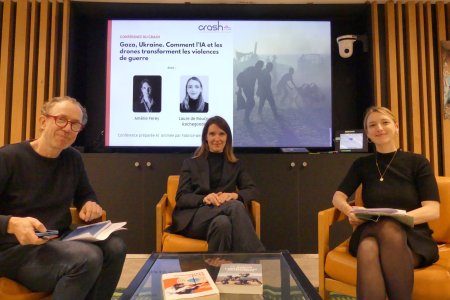 Mathilde Chong/MSF
Conference
Mathilde Chong/MSF
Conference
Gaza, Ukraine. How AI and drones are transforming the violence of war
10/14/2025 - 06:30 PM 08:30 PMOn Tuesday, October 14, 2025, the CRASH team was pleased to welcome Laure de Roucy-Rochegonde and Amélie Ferey for a conference on the transformation of war violence in the age of artificial intelligence (AI) and drones. The discussion was prepared and moderated by Fabrice Weissman.